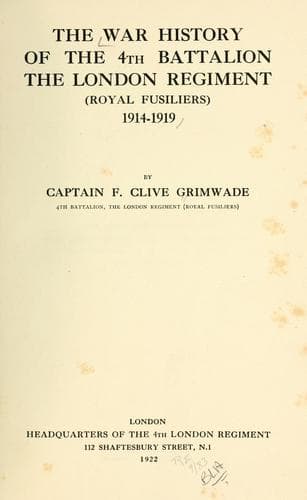
The War History of the 4th Battalion, the London Regiment (Royal Fusiliers), 1914-1919Grimwade, F. Clive
History
The War History of the 4th Battalion, the London Regiment (Royal Fusiliers), 1914-1919
Grimwade, F. Clive
Great Britain. Army. London Regiment. 4th (City of London) Battalion; World War, 1914-1918 -- Regimental histories -- Great Britain
The S.O.S. signal was received in Battalion Headquarters from Oppy
Post by wire at 7.15 a.m., and a few moments later flares were sent
up from Wood and Beatty. The signal was repeated backwards to Brigade
by Battalion Headquarters. "We stood on top," writes Lieut.-Col.
Marchment, "to have a look round but could see very little as it was
not fully light. We could, however, hear a pleasant noise--very heavy
rifle fire!"
Oppy Post on the left had been very badly knocked about by the
trench mortaring and the garrison seriously reduced before the enemy
came over. A gallant attempt at resistance was put up and rifle and
Lewis gun fire were opened as soon as the attacking lines made their
appearance. One Lewis gun team was seen from the rear to have climbed
on to the parapet, and the gun was being fired from the hip. But it was
hopeless from the first. The enemy lines were very close, and by sheer
weight of numbers the Post was quickly swamped. Of a garrison of 2
officers and 48 other ranks but 1 officer (2/Lieut. Athey) and 5 other
ranks were able to make their way back to the Marquis line which they
did by way of Boyne Trench.
On the right Beatty Post had suffered from the trench mortar fire more
severely than any, and by the time the Germans appeared its trenches
were practically effaced. The attackers appeared in fairly close
formation, and in considerable depth, some of the leading wave firing
rifle grenades from the hip. Apparently the enemy's trench mortar
preparation, severe as it had been, had not dealt effectively with
our wire, for the leading wave of attackers was delayed in getting
through it, causing those following to bunch up to it. The rapid rifle
and Lewis gun fire opened by the garrison of the post was thus able
to inflict very severe loss. For about fifteen minutes the garrison
stoutly held its own, but at the end of that time it was found that the
enemy had already swept over the posts to the right held by the L.R.B.,
and was working into Marine Trench and Ouse Alley in great numbers.
Again sheer weight of numbers made further resistance impossible, and
2/Lieut. G. R. Pitman brought the six surviving men back to the Marquis
line over the open, leaving 2 officers (Capt. E. E. Spicer and 2/Lieut.
Coombes) and 78 other ranks fallen at their posts.
Public-domain text, read in full here on John Shaqi.
Reviews
Reviews
No reviews yet
Be the first to share your thoughts on this work.
Elsewhere in the archive
Join the Discussion
Join the discussion
Sign in to leave a comment or review.
Sign InorCreate an account