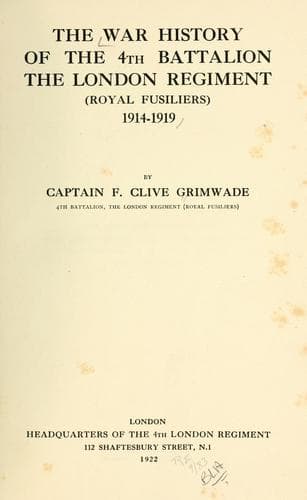
The War History of the 4th Battalion, the London Regiment (Royal Fusiliers), 1914-1919Grimwade, F. Clive
History
The War History of the 4th Battalion, the London Regiment (Royal Fusiliers), 1914-1919
Grimwade, F. Clive
Great Britain. Army. London Regiment. 4th (City of London) Battalion; World War, 1914-1918 -- Regimental histories -- Great Britain
The right subsection was defended by breastworks and was immediately
facing Pietre, the hamlet which had stood between our troops and
success on the afternoon of the 10th March. It included the peculiar
feature of the Duck's Bill, in regard to which a word of description
may not be out of place. The name Duck's Bill brings to the minds of
most 4th London men the picture of a large defended mine crater quite
close to the German line, and approached by a defended sap which was
generally full of water. Such it was in the winter of 1916/17, but in
the spring of 1915 the Duck's Bill was a ruined farmhouse standing on
a knoll just in front of the cross-road connecting Sign Post Lane with
Sunken Road. This ruin was surrounded by a horseshoe trench, the points
of the horseshoe resting on the cross-road, which was barricaded and
connected with the front line by a rough breastwork. The defences
here were still in an unfinished condition as the farmhouse was the
extreme point of our advance in this sector in the battle, and the road
barricades were under the continual watch of German snipers in Pietre.
On the night of our entry into this sector the farmhouse had just
been demolished by German incendiary shells and the ruins were still
smouldering.
"A Bosche had been buried," writes Captain Moore, "in the hastily
constructed parapet, face downward, and with his booted feet sticking
into our trench. They were Bosche boots, so presumably were on Bosche
feet, and every time one passed in the dark one knocked them--a truly
gruesome spot."
The Duck's Bill farmhouse was finally disposed of when the mine crater
was blown in 1916.
The reserve posts to which the companies in reserve were detailed were
defended keeps forming with others the Croix Barbée line of defence.
The aftermath of the battle, which had taken the form of such vigorous
shelling by the enemy, now exhausted itself and this tour proved
particularly quiet. The enemy's attention was paid principally to the
roads and communications in rear of our trenches, but his shelling was
sporadic and harmless.
On the 11th April the Battalion moved out of Croix Barbée, marching
at 5 p.m. for Paradis, where it was joined the following day by the
remaining units of the Brigade, now in Divisional reserve.
Of the rest in Paradis little need be said. The twelve days were spent
in training under company arrangements and in bathing, completing
issues of deficiencies in clothing, etc. On the 16th and 17th April,
however, practice attacks on trenches were carried out as a brigade
exercise, and although no definite information was, at the time,
conveyed to the units as regards the purpose of the practice, the
exercise was in preparation for the rôle which the Brigade would
be called upon to play during its next tour in the line. It was,
therefore, with the greater satisfaction that the 4th Londons carried
out the exercises in leading the assaulting columns beside the
Connaught Rangers.
Public-domain text, read in full here on John Shaqi.
Reviews
Reviews
No reviews yet
Be the first to share your thoughts on this work.
Join the Discussion
Join the discussion
Sign in to leave a comment or review.
Sign InorCreate an account