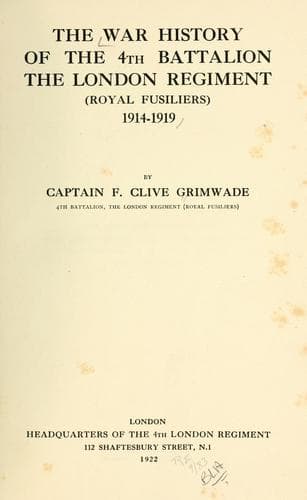
The War History of the 4th Battalion, the London Regiment (Royal Fusiliers), 1914-1919Grimwade, F. Clive
History
The War History of the 4th Battalion, the London Regiment (Royal Fusiliers), 1914-1919
Grimwade, F. Clive
Great Britain. Army. London Regiment. 4th (City of London) Battalion; World War, 1914-1918 -- Regimental histories -- Great Britain
The novitiate of the Battalion was now over, and it was accepted as
being in every way able to do its full duty as a unit of the Ferozepore
Brigade, and the knowledge that it had "found itself" was in itself the
best possible incentive to all ranks to uphold worthily the honour of
their regiment. The weather was of the most perfect spring type, and
the ground and dykes were once more in their normal condition for the
time of year. Speculation was rife, therefore, as to the task which was
destined to be set the Brigade on its return to the line.
A warning order was received that the Brigade would relieve the
Dehra Dun Brigade on Saturday, the 26th April, in a sector in front
of Neuve Chapelle village, extending from the La Bassée Road on the
right to Sign Post Lane on the left. The 4th Londons were to take over
the left centre subsection, the other front line battalions being
the Connaughts, the 9th Bhopals and the 57th Rifles, with the 129th
Baluchis in Brigade reserve. But this relief was destined not to take
place.
During the day disquieting rumours went round--started as inexplicably
as such rumours always are--that things were not well in the north near
Ypres: rumours of heavy fighting, of defeat, and of dastardly crimes on
the part of the enemy. That the incredible brutality of the Germans was
indeed an accomplished fact all the world now knows, and we must now
review the tremendous happenings in the Ypres salient which caused the
outbreak of a storm destined to rage with ever-increasing fury for the
next three weeks.
CHAPTER IV
THE 1/4TH BATTALION IN THE SECOND BATTLE OF YPRES, 1915
Since the exhaustion of the enemy's drive towards Ypres in November
1914, the Ypres area had not been the scene of any important
operations, although from time to time fierce struggles had raged here
and there for the possession of points of minor tactical importance.
Early in April 1915 the British lines had been extended slightly
northward, and a sector had been taken over from the French troops on
the left. On the 22nd of that month the line from Steenstraate (near
the Yser Canal) as far as the Poelcapelle Road east of Langemarck was
held by a Moroccan Division of the French Army. Thence the line took
a south-easterly turn towards the Passchendaele-Becelaere Road and
was occupied by the Canadian Division. On the right of the Canadians,
British divisions held the trenches which ran east of Zonnebeeke in the
direction of Hooge.
Public-domain text, read in full here on John Shaqi.
Reviews
Reviews
No reviews yet
Be the first to share your thoughts on this work.
Join the Discussion
Join the discussion
Sign in to leave a comment or review.
Sign InorCreate an account