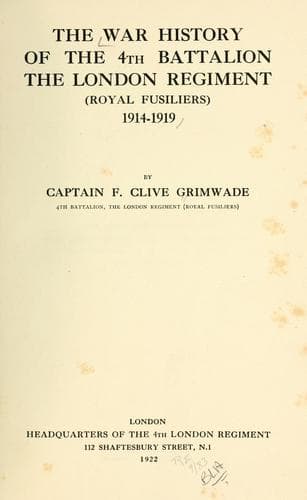
The War History of the 4th Battalion, the London Regiment (Royal Fusiliers), 1914-1919 — John Shaqi
The War History of the 4th Battalion, the London Regiment (Royal Fusiliers), 1914-1919Grimwade, F. Clive
History
The War History of the 4th Battalion, the London Regiment (Royal Fusiliers), 1914-1919
Grimwade, F. Clive
Great Britain. Army. London Regiment. 4th (City of London) Battalion; World War, 1914-1918 -- Regimental histories -- Great Britain
It was arranged between Sir John French and General Foch, who was in
command of the French Army on our left, that the latter should make
immediate arrangements for the recapture of the original French Line,
and for this purpose it was necessary for the British to maintain their
present position without further retirement; but it was clear that
the British troops could not be allowed to remain in the precarious
position held by them during the last twenty-four hours unless the
French attack were delivered within a reasonable time. In the meantime
such reinforcements as were immediately available from neighbouring
Corps were being rushed up into Ypres to strengthen the temporary line
between ourselves and the French.
On the 24th a heavy German attack breached our lines at St Julien. This
might have initiated an extremely critical situation but for a powerful
counter-attack organised and launched by Brig.-Gen. Hull (afterwards
G.O.C. 56th Division), who, with his own Brigade and parts of
battalions belonging to six different divisions all new to the ground,
was successful in stemming the tide of the enemy's advance, although
attempts to recapture St Julien were repulsed.
Early in the morning of the 25th the left flank of the Canadian
division was driven back after two days' magnificent fighting, and by
the evening the allied line north of Ypres ran practically east and
west from the neighbourhood of Boesinghe on the Canal to the south
outskirts of St Julien. The general tendency of this line was to bow
inwards towards Ypres. The seriousness of the threat to the whole
British position east of Ypres is obvious. It was now possible for the
enemy to shell any point in our lines from both sides of the salient,
while his positions being about two miles farther to the south than
they had been prior to the gas attack of the 22nd, he was able to keep
the arterial road from Ypres to Zonnebeeke under continuous and heavy
shell fire from guns of all calibres.
During the whole time considerable confusion was created by the
alteration of areas caused by the sudden relinquishment of the forward
positions; and by the fact that fresh troops on arrival in the Ypres
area had at once to be absorbed into the firing line to prevent
the enemy from exploiting his initial success. This confusion was
heightened by our lack of artillery, which was inadequate to keep
down the heavy German fire, and our casualties were in consequence
continuously heavy. Ypres was itself kept under very heavy shell fire
which vastly increased the difficulty of maintaining supplies of
munitions and food.
Public-domain text, read in full here on John Shaqi.
Reviews
Reviews
No reviews yet
Be the first to share your thoughts on this work.
Join the Discussion
Join the discussion
Sign in to leave a comment or review.
Sign InorCreate an account