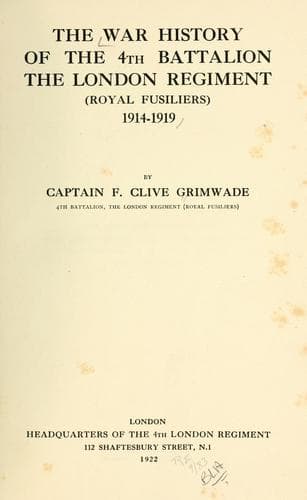
The War History of the 4th Battalion, the London Regiment (Royal Fusiliers), 1914-1919 — John Shaqi
The War History of the 4th Battalion, the London Regiment (Royal Fusiliers), 1914-1919Grimwade, F. Clive
History
The War History of the 4th Battalion, the London Regiment (Royal Fusiliers), 1914-1919
Grimwade, F. Clive
Great Britain. Army. London Regiment. 4th (City of London) Battalion; World War, 1914-1918 -- Regimental histories -- Great Britain
On the afternoon of the 22nd the French lines were subjected to a heavy
bombardment, following which at about 5 p.m. our aeroplanes reported
that they had seen thick clouds of yellow smoke issuing from the German
trenches between Langemarck and Bixschoote. These arose, as is now
well known, from poison gas, of which the effect was so terrible as to
render the troops exposed to it practically incapable of action. The
smoke and fumes at first hid everything from sight, and hundreds of
men were immediately incapacitated. Within an hour the whole position
had to be abandoned with the loss of fifty guns. This horrible and
unlooked-for attack was so overpowering in its moral effect that our
gallant allies were unable to combat it, and being totally unprovided
with means of defence against so diabolical a contrivance, were
forced--as indeed any troops would probably have been under the like
conditions--to abandon their position without offering resistance. The
confusion and moral effect were doubtless increased by the fact that
the trenches thus attacked were occupied by Africans whose firm belief
in the supernatural rendered it so much the more difficult for them to
withstand this assault.
The immediate result of this gas attack was that the left flank of the
Canadian Division was in the air and was in imminent danger of being
entirely cut off. But the Canadians stuck to their positions with
magnificent tenacity and during the night repulsed numerous German
attacks. In the disorganisation following the gas attack the Germans
had succeeded in establishing themselves on the west side of the
Yser Canal at Lizerne, thus threatening to drive a wedge between the
Canadians on the right and the French and Belgian troops on the left.
By 10 o'clock the next morning the position, though by no means
re-established, was slightly easier, touch being definitely ensured
between the Canadians' left and the French right, about 800 yards
east of the Canal; but in order to effect this junction so great an
extension of the British lines had been necessary that no reserves were
available for counter-attack. The enemy's artillery fire was severe all
day and the situation was rendered exceptionally difficult by the loss
of so many allied guns in the gas attack.
Public-domain text, read in full here on John Shaqi.
Reviews
Reviews
No reviews yet
Be the first to share your thoughts on this work.
Join the Discussion
Join the discussion
Sign in to leave a comment or review.
Sign InorCreate an account