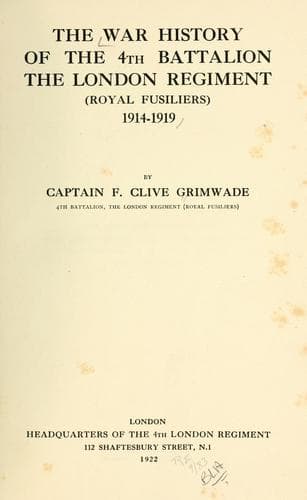
The War History of the 4th Battalion, the London Regiment (Royal Fusiliers), 1914-1919Grimwade, F. Clive
History
The War History of the 4th Battalion, the London Regiment (Royal Fusiliers), 1914-1919
Grimwade, F. Clive
Great Britain. Army. London Regiment. 4th (City of London) Battalion; World War, 1914-1918 -- Regimental histories -- Great Britain
But the end of the march was not yet. After a hasty breakfast the
Battalion was again on parade before 6 o'clock on the morning of the
25th, and once more joining the Brigade Column struggled up the steep
hill at Boescheppe, at the top of which another delay was caused
by a cross-current of vehicular traffic. The distress of the troops
was now so evident that orders were received to lighten packs, and
garments of all sorts, principally gifts of knitted garments sent out
from ladies in England, were left by the roadside. Through Westoutre
and Reninghelst the column marched on to Ouderdom, where it arrived at
about 2.30 p.m. with orders to billet in huts. Most of the huts were
already fully occupied and the greater part of the 1/4th Londons were
compelled to bivouac in the fields adjoining. Ouderdom is about seven
miles south-west of Ypres, and the object of the forced march was at
last clear. Some little idea of the storm raging in the salient could
be gathered from the bivouacs, as throughout the afternoon and night
the air vibrated with the continuous thunder of artillery in which the
rapid and sharp rafales of the French "seventy-fives" away to the north
were plainly distinguishable.
Shortly after midnight orders were received that the Division would
be pushed into the firing line that day, the 26th April, and at dawn
the Battalion was once more formed up. Shovels and picks were issued
alternately to all the troops for the purpose of digging themselves
into such positions as they might be able to gain, and to each platoon
was issued a yellow flag for signalling its location to the artillery.
In these early days of the War no arrangements were made for the
formation of a "battle surplus," and consequently the whole available
strength of officers and men prepared to move forward. Packs were now
stacked to relieve the troops of superfluous weight, and at 4.30 a.m.
the companies began to move off at five minutes' intervals.
The exhaustion of the men made progress inevitably slow. The roads
traversed were fortunately not receiving much attention from the
enemy's artillery, though a steady bombardment of Ypres with shells of
the heaviest calibre was proceeding. By about 9.30 a.m. the Battalion
was concentrated in a field adjoining Outskirt Farm at La Brique, where
it proceeded to dig itself into assembly trenches (see map No. 3).
Meanwhile the Jullundur Brigade had concentrated farther to the east,
between St Jean and Wieltje, while the Sirhind Brigade in Divisional
Reserve had moved round the south of Ypres to a position north-west of
Potizje.
Public-domain text, read in full here on John Shaqi.
Reviews
Reviews
No reviews yet
Be the first to share your thoughts on this work.
Join the Discussion
Join the discussion
Sign in to leave a comment or review.
Sign InorCreate an account