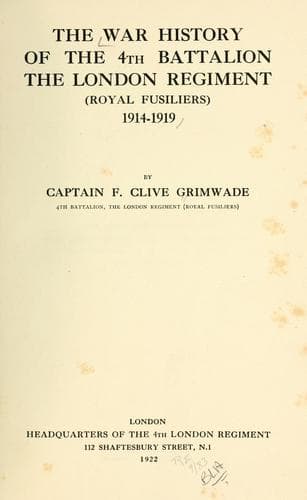
The War History of the 4th Battalion, the London Regiment (Royal Fusiliers), 1914-1919Grimwade, F. Clive
History
The War History of the 4th Battalion, the London Regiment (Royal Fusiliers), 1914-1919
Grimwade, F. Clive
Great Britain. Army. London Regiment. 4th (City of London) Battalion; World War, 1914-1918 -- Regimental histories -- Great Britain
The 1/4th Londons' position[1] during the hours of waiting in the
morning was behind the crest of the spur which runs westward from St
Jean, past La Brique towards the Canal, and though out of view from the
German trenches was undoubtedly located by the enemy's Taubes, whose
reconnaissances over our lines were entirely unmolested. This, combined
with the close proximity of the Battalion's position to several British
and French batteries, brought it a fair share of German shrapnel during
the morning, the shelling being from both the north and south sides of
the salient. Happily but few casualties were sustained.
[1] It has been thought convenient in the account of this action to
designate buildings and other topographical features by the names by
which they afterwards became generally known, though they were not in
every case so named in April 1915.
Below the hillside on which the Battalion lay concealed and distant
something more than half a mile the gaunt ruins of Ypres stood out
clearly in the morning sunlight, the fast-crumbling tower of its
wonderful Cloth Hall still erect, a silent witness of the tragedy
which was being enacted. All the morning shells were falling into the
town, a steady and merciless bombardment without the least cessation
or abatement. From the centre of the town dense columns of black smoke
rose continuously, and the crash of explosions and the clatter of
falling débris followed each other without respite. The cross-roads
at which the St Jean road left the town were in particular a target
for the German heavy guns. All the morning the 50th (Northumberland)
Division T.F. was moving from Ypres along this road to St Julien, and
as each platoon passed the fatal cross-road at the double a heavy shell
fell close by thinning the ranks. It seemed to every spectator of this
horrible yet fascinating sight that the German artillery fire must
surely be directed from some point within the British lines.
At 12.40 p.m. the Brigade received orders to prepare to take part in
a divisional attack in conjunction with the French in a due northerly
direction, with the object of relieving the pressure on the left of St
Julien and of endeavouring to push the enemy back. With this attack the
50th Division would co-operate on the right of the Lahore Division in
an attempt to recapture St Julien itself.
The Ferozepore Brigade's frontage was on the right of Boundary Road
(the Ypres-Langemarck Road) and extended as far as English Farm, beyond
which the Jullundur Brigade was responsible as far as Wieltje Farm on
the extreme right, and the general line of assembly was on the forward
slope of the spur some 600 yards north of La Brique.
The Brigade's advance was led by the Connaught Rangers on the left,
the 57th Rifles in the centre, with the 129th Baluchis on the right.
The 1/4th Londons were to follow the Connaughts, while the 9th Bhopals
remained in reserve in La Brique.
Public-domain text, read in full here on John Shaqi.
Reviews
Reviews
No reviews yet
Be the first to share your thoughts on this work.
Join the Discussion
Join the discussion
Sign in to leave a comment or review.
Sign InorCreate an account