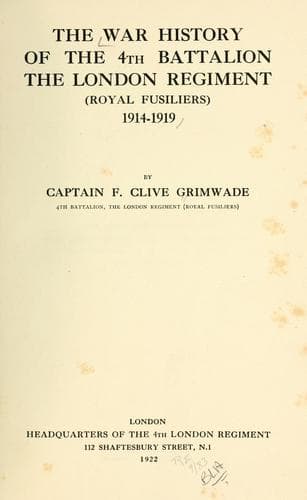
The War History of the 4th Battalion, the London Regiment (Royal Fusiliers), 1914-1919Grimwade, F. Clive
History
The War History of the 4th Battalion, the London Regiment (Royal Fusiliers), 1914-1919
Grimwade, F. Clive
Great Britain. Army. London Regiment. 4th (City of London) Battalion; World War, 1914-1918 -- Regimental histories -- Great Britain
16. THE DEFENCE OF ARRAS, MARCH 1918 400
17. THE BATTLE OF AMIENS, 1918 (2/4TH BATTALION)--THE
ACTION AT CHIPILLY RIDGE, 8TH-10TH
AUGUST 432
18. THE BATTLE OF BAPAUME, 1918 (2/4TH BATTALION) 448
19. THE BATTLE OF BAPAUME, 1918 (1/4TH BATTALION) 472
20. THE BATTLE OF CAMBRAI, 1918--THE CANAL DU
NORD 488
21. THE BATTLE OF THE SAMBRE, 1918 496
CHAPTER I
MOBILISATION--DEPARTURE OVERSEAS
Of the London Volunteer Corps the unit now known as the 4th (City of
London) Battalion, The London Regiment (Royal Fusiliers) is one of
the most ancient. Called out as a Trained Band in 1643 to share in
repelling a threatened Royalist invasion of the City during the Civil
Wars, it has had a practically unbroken history for nearly three
hundred years. After the regular constitution of the Volunteer Forces
in the middle of last century it achieved some distinction as the 1st
Tower Hamlets Rifle Brigade, and despatched a machine-gun detachment
to the fighting in South Africa in 1900. In 1903 it became affiliated
to The Royal Fusiliers, as the 4th Volunteer Battalion of that
distinguished Regiment. On the reorganisation of the auxiliary forces
in 1908 by Lord Haldane, it acquired its present designation, which we
will abbreviate to the more convenient title by which it became known
in the Great War, namely, The 4th London Regiment.
Prior to the War the training provided for the Territorial Force was
only such as to furnish the nucleus of a Second Line Army. Fourteen
days in camp each summer, an easy musketry course, and a few drills
at headquarters could not develop a soldier fit to meet fully trained
troops. That this was recognised by Lord Haldane is evidenced by the
fact that his scheme provided for a period of six months' training at
home for all Territorial soldiers should war break out, prior to their
despatch on active service.
But they were none the less given a definite rôle in the defence of the
Motherland. Possibly this was not always realised to the full by all
the officers and non-commissioned officers of the Regiment; but it was
unmistakably brought home to them one evening in February 1914 when a
secret meeting of officers was convened at Headquarters in Hoxton for
the explanation of the scheme of mobilisation and of the task which the
Regiment would be called upon to execute should war occur.
Public-domain text, read in full here on John Shaqi.
Reviews
Reviews
No reviews yet
Be the first to share your thoughts on this work.
Join the Discussion
Join the discussion
Sign in to leave a comment or review.
Sign InorCreate an account