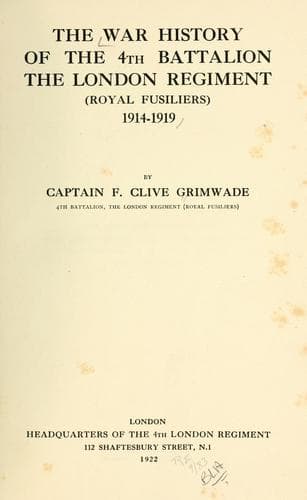
The War History of the 4th Battalion, the London Regiment (Royal Fusiliers), 1914-1919Grimwade, F. Clive
History
The War History of the 4th Battalion, the London Regiment (Royal Fusiliers), 1914-1919
Grimwade, F. Clive
Great Britain. Army. London Regiment. 4th (City of London) Battalion; World War, 1914-1918 -- Regimental histories -- Great Britain
The Battalion continued to advance as far as Buffs Road, where a halt,
believed at first to be temporary, was called. No trench line existed
here but the ditch on the near side of the road had been widened. This
was already filled with the remains of the 2nd K.O.S.B. (who had been
fighting continuously since the action at Hill 60 on the 17th April,
and were now reduced to under 100 all ranks) and by the reserve company
of the Connaughts. The majority of the Battalion were, therefore,
unable to obtain shelter in the ditch, and the digging of a fresh line
some fifteen yards in rear was at once put in hand.
Early in the advance Moore (B Coy.) was hit in the foot and his company
was taken over by Grimwade. Considering the severity of the enemy's
shrapnel fire the advance was made with surprisingly few casualties,
and although owing to the massing of the whole Battalion on one line
of narrow frontage some intermingling of platoons on halting was
inevitable, this was rapidly set to rights with little difficulty. The
enemy's bombardment soon died away considerably, though for a while he
maintained a steady machine-gun fire sweeping the crest of the ridge
ahead of Buffs Road.
The troops leading the attack had moved forward steadily at zero hour
and had pushed over the crest line in front of Buffs Road descending
the further slope towards Turco Farm. The front German trench north
of the Farm was reached and occupied, but before the position was
properly established dense yellow clouds of poison gas issued from
the enemy lines and, being gently wafted by the breeze, bore down on
our defenceless troops. Under the horror of this ordeal the greater
part of the line broke and a general retirement ensued which affected
most severely the French and Indian Battalions, as already described.
About 100 of the Connaughts and the Manchesters (Sirhind Brigade),
however, managed to cling gallantly to their ground under Major
Deacon, though they were shortly afterwards ejected by a strong enemy
counter-attack which followed the gas cloud. They eventually succeeded
in consolidating a line in the immediate vicinity of Turco Farm.
Shortly after the 1/4th Londons were established on Buffs Road
Lieut.-Col. Botterill became a casualty, and Major L. T. Burnett
assumed command of the Battalion. It was decided by Major Burnett that
the overcrowding of the Buffs Road alignment was so great and wasteful
of fire power, quite half the Battalion being unable to get into
position to use their rifles, that a redisposition of his forces was
desirable, and accordingly C and D companies withdrew to a position in
support some 300 yards in rear of Buffs Road, where they dug themselves
in.
During this time the Regimental Aid Post under Lieut. Hurd, R.A.M.C.,
was established at Irish Farm and the Battalion stretcher-bearers under
Corpl. Fulford worked with great coolness in evacuating the wounded
under heavy fire.
[Illustration: THE SECOND BATTLE OF YPRES, 1915]
Public-domain text, read in full here on John Shaqi.
Reviews
Reviews
No reviews yet
Be the first to share your thoughts on this work.
Join the Discussion
Join the discussion
Sign in to leave a comment or review.
Sign InorCreate an account