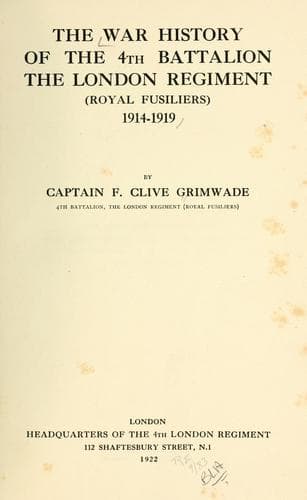
The War History of the 4th Battalion, the London Regiment (Royal Fusiliers), 1914-1919 — John Shaqi
The War History of the 4th Battalion, the London Regiment (Royal Fusiliers), 1914-1919Grimwade, F. Clive
History
The War History of the 4th Battalion, the London Regiment (Royal Fusiliers), 1914-1919
Grimwade, F. Clive
Great Britain. Army. London Regiment. 4th (City of London) Battalion; World War, 1914-1918 -- Regimental histories -- Great Britain
At 2 o'clock the attack was launched under a heavy bombardment from all
available British and French batteries, but such was the shortage of
ammunition that this support died down for lack of supplies in about
five minutes, after which the German batteries were free to search
intensively the whole area of the Brigade advance, causing a good many
casualties in the assaulting columns.
From the line of assembly the ground subsided gently to a shallow
depression running across the direction of advance, beyond which, at a
distance of some 1000 yards from the crest on the La Brique side, the
hill swelled to a second skyline which impeded further view. Just below
the crest of the further spur an unfenced lane, Buffs Road, followed
the contour running eastwards from Boundary Road. None of this land was
intersected by trenches, the Allied trenches being several miles ahead
and to the rear of the German positions.
The 1/4th Londons moved from their position of waiting at about 2.30
p.m., and shaking out into four lines of platoons in file with B
Company (Moore) on the left, and A (Duncan-Teape) on the right of the
front line, followed by D (Saunders) and C (Clark). The German shrapnel
was now searching both slopes of the spur pretty severely and men
began to drop, but the Battalion steadily breasted the rise from which
it could overlook the shallow valley towards Buffs Road. The sight
which met their eyes defies description. The valley was covered with
a ragged crowd of agonised and nerve-racked men, both Moroccans and
Indians, who, having thrown down their arms and everything which could
impede them, were streaming back from the front trenches suffering
the tortures of poison gas. It was a revolting sight. The attack had
clearly failed and our leading troops were broken and in retirement.
But the men of the 1/4th Londons were splendid. Without wavering for
a single instant they trudged steadily forward, though indeed almost
completely exhausted, maintaining the intervals and distances between
platoons with the precision of the parade ground. Never was there a
more striking example of the results of training and discipline. The
"attack in open warfare" which had been so roundly cursed by one and
all in the days of training at Blendecques had indeed so sunk into the
minds of everyone that instinctively the troops remembering only their
orders to "follow the Connaughts at all costs" carried out under the
most trying ordeal the lessons which had been drilled into them.
Public-domain text, read in full here on John Shaqi.
Reviews
Reviews
No reviews yet
Be the first to share your thoughts on this work.
Join the Discussion
Join the discussion
Sign in to leave a comment or review.
Sign InorCreate an account