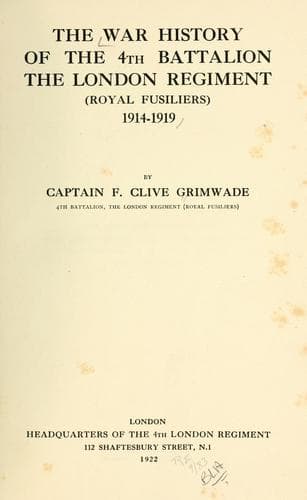
The War History of the 4th Battalion, the London Regiment (Royal Fusiliers), 1914-1919 — John Shaqi
The War History of the 4th Battalion, the London Regiment (Royal Fusiliers), 1914-1919Grimwade, F. Clive
History
The War History of the 4th Battalion, the London Regiment (Royal Fusiliers), 1914-1919
Grimwade, F. Clive
Great Britain. Army. London Regiment. 4th (City of London) Battalion; World War, 1914-1918 -- Regimental histories -- Great Britain
The 27th April broke grey and cold and the morning was misty. During
the early hours the enemy's artillery was remarkably inactive and the
work of strengthening the Battalion's position was proceeded with
without molestation by the Germans. The signs of battle were few indeed
and it seemed almost impossible to realise the critical position of
the British troops. The sense of detachment from the serious events
of the preceding afternoon was enhanced by the unbroken state of the
countryside in the immediate neighbourhood and the presence of several
cows, which by some marvellous chance had escaped the enemy's shells
and continued to graze lazily in the field in rear of the Battalion's
position, as they had done during the battle on the previous afternoon.
The lull, however, was only the calm which proverbially precedes the
storm, for about noon the enemy's guns opened with intense violence on
the British positions and the 1/4th Londons received their full share
of these hostile attentions. Fortunately, however, its position behind
the crest secured it from heavy loss.
During this bombardment Major Burnett was ordered to report to Brigade
Headquarters, where he received orders for an attack to take place
in half an hour's time. When he got back to the Battalion under ten
minutes were left in which to explain the orders to his company
commanders and to make all preparations. The Battalion was to execute a
further advance in a north-easterly direction on to Oblong Farm, which
was given as the objective. In order to reach the assembly position,
it was necessary for the Battalion to move about 200 yards to the
right flank in order to come up on the right of the Sirhind Brigade,
who, in the early hours of the morning, had relieved the most advanced
troops of the Ferozepore Brigade.
The hurried nature of the attack precluded any possibility of
reconnaissance of the ground by the officers and allowed no time for
the explanation of the work on hand to the rank and file. The position
of the German trenches was unknown and the difficulties and obstacles
which might be met with during the advance were entirely undisclosed.
The movement of the Battalion toward its position of assembly for
this unpromising enterprise was carried out steadily although with
considerable loss. The British and Canadian artillery, which were
co-operating in giving support to the attack, were again lamentably
short of ammunition, so that an intense bombardment of some five
minutes left them unable to render further assistance. Thus as the
Battalion in moving to its flank came near the crest of the spur behind
which it had hitherto been concealed from direct observation by the
enemy, it became a very clear target for the hostile artillery, and the
German guns being no longer harassed by our artillery, were able to
pour a devastating fire upon the companies.
Public-domain text, read in full here on John Shaqi.
Reviews
Reviews
No reviews yet
Be the first to share your thoughts on this work.
Join the Discussion
Join the discussion
Sign in to leave a comment or review.
Sign InorCreate an account