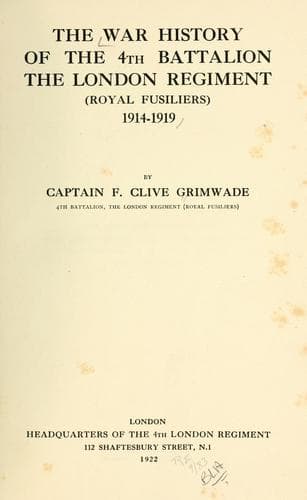
The War History of the 4th Battalion, the London Regiment (Royal Fusiliers), 1914-1919Grimwade, F. Clive
History
The War History of the 4th Battalion, the London Regiment (Royal Fusiliers), 1914-1919
Grimwade, F. Clive
Great Britain. Army. London Regiment. 4th (City of London) Battalion; World War, 1914-1918 -- Regimental histories -- Great Britain
The actual "jumping-off" position was the ditch on the south side of
Buffs Road which, at this point, was bordered by a hedge. The Battalion
advanced in two lines of two companies in open order, each company
formed in three waves, and the leading companies were C (Clark) on
the left and D (Saunders) on the right, followed respectively by B
(Grimwade) and A (Duncan-Teape). In order to ensure that the waves in
each company should move forward together, it was necessary to collect
the whole of each wave in the ditch before it moved; and this could
only be effected by "feeding" the men along the ditch in single file,
from the western end of the Battalion's frontage, the hedge in rear
being impenetrable. The result of this slow progress was that the
remainder of the Battalion waiting its turn to go into the ditch was
compelled to wait on the hill, under a high explosive and shrapnel fire
which was both intense and accurate. The result needs no description,
but under this very trying ordeal the Battalion was perfectly steady,
each platoon grouped together and waiting its order to move with the
greatest nonchalance.
Before following the actual advance of the 1/4th Londons it will be
convenient to explain the object and scope of the operation of which it
formed part.
During the morning arrangements had been made for the Lahore Division
to co-operate in an attack which was projected by the French Brigade
Moroccaine. The general direction of the French attack was to be along
the Ypres-Langemarck Road, as on the previous day, and the Lahore
Division was to take all possible advantage of the French advance
to gain ground, but without committing itself to the attack before
the French troops had secured its left flank. The Lahore Division's
attack was to conform to the French movement but on the east side of
the Langemarck Road; the Sirhind Brigade occupying the left of the
Divisional front next the French with the Ferozepore Brigade on its
right.
The objective of the latter was, as already stated, Oblong Farm, a
moated farmstead some 1700 yards from starting-point, the attack being
led by the 1/4th Londons on the left and the 9th Bhopals on the right.
The Connaughts followed in support at a distance of 400 yards, while
the 57th Rifles and the 129th Baluchis, both of which regiments had
been seriously weakened in the action of the 26th, were in reserve.
Public-domain text, read in full here on John Shaqi.
Reviews
Reviews
No reviews yet
Be the first to share your thoughts on this work.
Join the Discussion
Join the discussion
Sign in to leave a comment or review.
Sign InorCreate an account