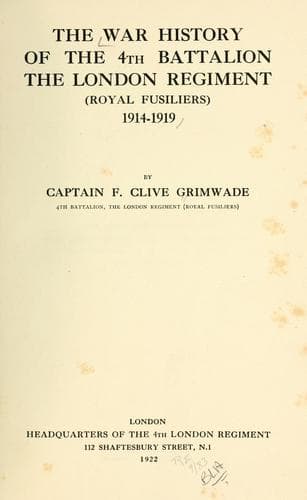
The War History of the 4th Battalion, the London Regiment (Royal Fusiliers), 1914-1919Grimwade, F. Clive
History
The War History of the 4th Battalion, the London Regiment (Royal Fusiliers), 1914-1919
Grimwade, F. Clive
Great Britain. Army. London Regiment. 4th (City of London) Battalion; World War, 1914-1918 -- Regimental histories -- Great Britain
On the 9th the 140th Brigade was relieved in the line by the 142nd,
moving on the 13th into the Loos sector, where it took over the
trenches of the 141st Brigade. The 1/4th Londons did not take part in
this relief but remained in the right subsection, temporarily under
the orders of the 142nd Brigade, with the 22nd Londons on their left.
Here the Battalion remained until the 16th, when it was relieved by
the 17th Battalion, rejoining the 140th Brigade in rest billets at
Haillicourt.
On the 19th January Lieut.-Col. L. T. Burnett left the Battalion on
short leave, and as it unfortunately proved, permanently, for he
fell seriously ill while on leave and was unable to return to duty
for nearly a year. The command was assumed during his absence by
Major W. G. Clark, D.S.O., while Major S. Elliott became temporarily
second in command. The loss of Lieut.-Col. Burnett was keenly felt.
His nine months' command had been marked by a striking advance in the
Battalion's efficiency and by the unswerving loyalty of all ranks under
his command. Later he joined the Reserve Battalion in England, being
subsequently transferred to employment in the War Office.
At Haillicourt the Battalion spent a few days in rest and training
and returned to the trenches on the 24th January, occupying the same
subsector as on the previous occasion with the 7th Londons once more on
its left.
This tour of duty was marked by particularly heavy artillery activity
on both sides, the Germans shelling our trenches and Maroc daily with
great accuracy and using a good deal of gas shell. A certain number of
casualties inevitably occurred, but, having regard to the continued
intensity of the bombardment, the number was remarkably small.
On the 27th January the Kaiser's birthday was celebrated, and it was
somewhat confidently anticipated that, as in 1915, the Germans would
endeavour to score some success against the British. It had been known
for some time that enemy mining operations in this area had been
proceeding apace, and it therefore appeared not improbable that the
Germans would endeavour to time the firing of their mines for the 27th.
Preparations to meet this possibility were made. The Kaiser's birthday
did indeed prove to be a day of considerable activity, and though the
Germans delivered an abortive attack against the 15th Division on the
left no infantry movement occurred opposite the 140th Brigade; and
their activity was confined to shell fire, which assumed serious
proportions on the 27th and again on the 28th. Our artillery, however,
was ready with heavy retaliatory fire and by the evening of the 30th
conditions in the Maroc sector had reverted to something approaching
quietness.
Public-domain text, read in full here on John Shaqi.
Reviews
Reviews
No reviews yet
Be the first to share your thoughts on this work.
Elsewhere in the archive
Join the Discussion
Join the discussion
Sign in to leave a comment or review.
Sign InorCreate an account