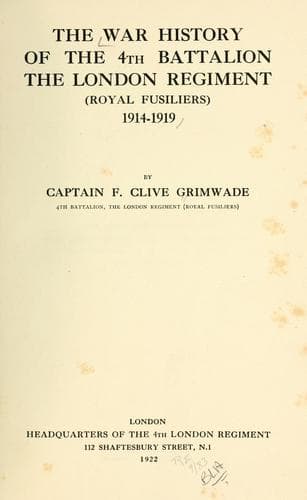
The War History of the 4th Battalion, the London Regiment (Royal Fusiliers), 1914-1919 — John Shaqi
The War History of the 4th Battalion, the London Regiment (Royal Fusiliers), 1914-1919Grimwade, F. Clive
History
The War History of the 4th Battalion, the London Regiment (Royal Fusiliers), 1914-1919
Grimwade, F. Clive
Great Britain. Army. London Regiment. 4th (City of London) Battalion; World War, 1914-1918 -- Regimental histories -- Great Britain
The early days of August on the railway line afforded unmistakable
proof, if such were needed, of the extraordinary power of the London
soldier to adapt himself to circumstances. Men from offices, factories
and docks, suddenly taken from their occupations and their homes,
settled down to patrols and guards, to cooking their food and taking
responsibility, as to the manner born. All were swept forward on the
high flood of a great enthusiasm, and buoyed up amid minor discomforts
with intense pride that their country needed them and had given them
a job of work to carry out. This enthusiasm certainly bid fair at
times to show signs of excess of zeal. But the zeal was tempered with
an immense sense of the dignity of each and every one as a soldier
in the 4th Londons: the days on railway guard thus formed the basis
of the _esprit de corps_ which is essential to military success and
which in pre-war days it had been difficult, by the nature of things,
to develop. Scattered though the Battalion was over some 50 miles of
railway, disciplinary trouble of a serious nature was conspicuous by
its absence.
By the middle of August the greater part of the Expeditionary Force had
been embarked to France, but the Brigade remained at its war station.
During the dark days which ensued, when telegram after telegram told
always of withdrawal before overwhelming forces of the German Army
after the glorious resistance at Mons, the Battalion continued to guard
the railway, and was busily occupied in recruiting to full strength
and in completing its equipment. The strength of the Battalion rose
steadily and rapidly, and by the end of August 941 N.C.O.'s and men
were at duty on the railway line.
The duties on the railway were extremely heavy, and no training was
possible except the rudimentary instructions of the recruits who were
retained at peace headquarters.
On the night of 31st August / 1st September orders were issued to the
Brigade to withdraw from the line and return to peace headquarters.
The move was satisfactorily completed by 12 noon on the 1st September,
the duties of the Brigade on the railway being taken over two days
later by the 3rd London Infantry Brigade. On return to headquarters the
Commanding Officer informed the Battalion that the whole Brigade would
be despatched on overseas garrison duty almost immediately, and called
for volunteers, a call which met with a favourable response from all
ranks.
The two following days were actively occupied with medical inspections,
recruiting to fill the few remaining vacancies, etc.
Public-domain text, read in full here on John Shaqi.
Reviews
Reviews
No reviews yet
Be the first to share your thoughts on this work.
Join the Discussion
Join the discussion
Sign in to leave a comment or review.
Sign InorCreate an account