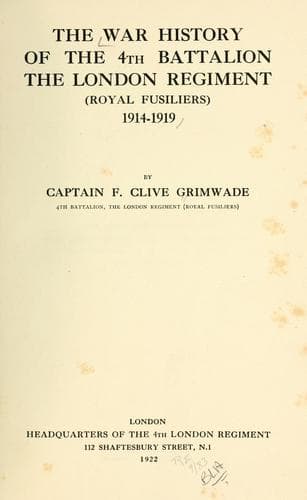
The War History of the 4th Battalion, the London Regiment (Royal Fusiliers), 1914-1919Grimwade, F. Clive
History
The War History of the 4th Battalion, the London Regiment (Royal Fusiliers), 1914-1919
Grimwade, F. Clive
Great Britain. Army. London Regiment. 4th (City of London) Battalion; World War, 1914-1918 -- Regimental histories -- Great Britain
Blankets, lanterns and other stores sent up the River from Woolwich
were unloaded and conveyed direct to the platform at Waterloo Station,
ready for issue to the Battalion on its arrival there. The machine was
moving steadily. During the day the Regimental Colours were handed over
to the Lord Mayor of London for safe keeping.
Shortly after midnight the 4th London Regiment entrained at Waterloo in
two trains, from which at each stop the allotted platoons detrained: so
that by the time the end of the sector was reached in the early hours
of the 4th August 1914, the railway was already guarded. Eighteen hours
before the declaration of war the Battalion was on its war station: a
good lead from Territorial troops to the rest of the country!
The distribution of the Battalion was as follows:
Battalion Headquarters, Lieut.-Col. G. P. Botterill, Surbiton.
A and B Companies (forming No. 1 Double Company), Headquarters at
Clapham Junction, under Capt. H. J. Duncan-Teape.
C and E Companies (forming No. 2 Double Company), Headquarters at
Woking, under Capt. G. H. M. Vine.
D and F Companies (forming No. 3 Double Company), Headquarters at
North Camp, under Capt. R. J. Jackson.
G and H Companies (forming No. 4 Double Company), Headquarters at
Bentley, under Capt. E. H. Stillwell.
The Transport Section returned to Headquarters at Hoxton to complete
the formation of the Battalion transport on a war footing.
Brigade Headquarters were at Waterloo Station under command of
Brigadier-General the Earl of Lucan. The Brigade Major was Major
R. F. Legge (Leinster Regiment); and the Staff Captain, Captain
Cornelius-Wheeler (3rd London Regiment, Royal Fusiliers).
On the evening of the same day Lord Grey of Falloden (then Sir Edward
Grey), in the House of Commons, made his never-to-be-forgotten
indictment of the duplicity of Germany's action in the pre-war
negotiations and in her violation of Belgian neutrality, and the formal
declaration of war followed.
The order for General Mobilisation, which was applicable to the
Territorial Force equally with the Regular Army, immediately ensued,
and orders to report forthwith were issued to all members of the
Battalion who had not paraded for the summer training two days
previously. It is to the credit of the Battalion that within twelve
hours no member had failed to reply. The N.C.O.'s and men thus
reporting for duty were as quickly as possible despatched from peace
headquarters and reported to their respective companies on the line.
As the N.C.O.'s and men of the Battalion reported for duty they
were subjected to medical examination, and a certain number were
unfortunately unable to pass fit at the high standard required during
the early days of the war, so that the strength of the Battalion on the
6th August was 24 officers and 785 N.C.O.'s and men.
Public-domain text, read in full here on John Shaqi.
Reviews
Reviews
No reviews yet
Be the first to share your thoughts on this work.
Join the Discussion
Join the discussion
Sign in to leave a comment or review.
Sign InorCreate an account