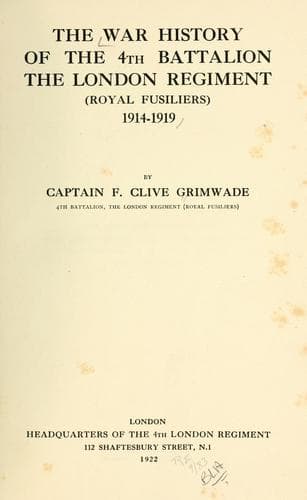
The War History of the 4th Battalion, the London Regiment (Royal Fusiliers), 1914-1919Grimwade, F. Clive
History
The War History of the 4th Battalion, the London Regiment (Royal Fusiliers), 1914-1919
Grimwade, F. Clive
Great Britain. Army. London Regiment. 4th (City of London) Battalion; World War, 1914-1918 -- Regimental histories -- Great Britain
On the 6th-8th June a last attempt was made on the Helles front to
carry the village of Krithia and the slopes of Achi Baba, but this
attack met with a similar fate to its predecessors, and the nett result
after a severe struggle was an advance of some 200 yards; the line thus
gained representing the most advanced position ever occupied on this
front.
As a result of strong representations by the Commander-in-Chief, fresh
forces were concentrated by the end of June consisting of the 10th,
11th and 13th Divisions of the New Armies, and the 52nd (Lowland),
53rd (Wessex) and 54th (East Anglian) Territorial Divisions, the two
last-named being represented by infantry only.
The impossibility of attaining further success by frontal attacks at
Helles now being clear, Sir Ian Hamilton determined to employ his fresh
forces in endeavouring to strangle the Turkish defence by an attack
across the Peninsula from Anzac, in a south-easterly direction towards
Maidos; supported by a fresh landing farther up the coast at Suvla Bay.
[Illustration: _V Beach, Cape Helles_]
The new operation was launched on the 6th August. The main attack from
Anzac involved as a preliminary objective the occupation of the heights
of Sari Bair, the possession of which would enable us to bring rifle
fire to bear on the enemy communications with Helles and, moreover,
bring the Narrows within field-gun range. So nearly to success did
this attack attain that had it received the support which had been
anticipated from the Suvla Bay landing, with its consequent diversion
of Turkish reserves, there can be little doubt that the advance would
have developed into one of first-rate importance. New Zealand troops
did, in fact, scale the heights of the main ridge, but in subsequent
counter-attacks were forced to yield to the enemy, and the few hundred
yards of ground which stood between us and decisive victory were denied
to us.
The actual landing at Suvla on the 8th was effected, as had been
hoped, as a complete surprise to the enemy, and met with little
resistance. But the exhaustion of the troops, caused by a failure
in the water supply arrangements, led to the waste of many valuable
hours of daylight in which no advance was possible and enabled the
enemy to prepare a stubborn resistance to our further attacks, and the
opportunity passed for ever.
During August and September the supply of reinforcements and munitions
for the Dardanelles Army fell off seriously, and in the middle of
October the position had become stabilised.
Public-domain text, read in full here on John Shaqi.
Reviews
Reviews
No reviews yet
Be the first to share your thoughts on this work.
Elsewhere in the archive
Join the Discussion
Join the discussion
Sign in to leave a comment or review.
Sign InorCreate an account