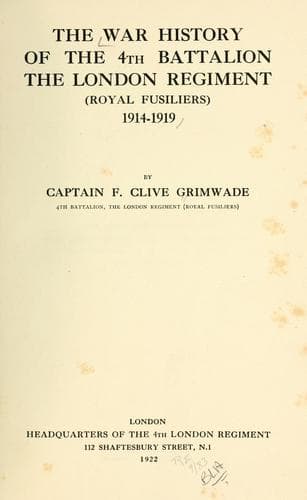
The War History of the 4th Battalion, the London Regiment (Royal Fusiliers), 1914-1919Grimwade, F. Clive
History
The War History of the 4th Battalion, the London Regiment (Royal Fusiliers), 1914-1919
Grimwade, F. Clive
Great Britain. Army. London Regiment. 4th (City of London) Battalion; World War, 1914-1918 -- Regimental histories -- Great Britain
The general situation had indeed changed most unfavourably for our
chances of ultimate success. The wholesale retirement of our Russian
Allies during the summer had released large numbers of enemy reserves
for the Gallipoli theatre, and the recrudescence of enemy submarine
activity in the Ægean Sea increased the difficulties of supply and
transport from the bases at Mudros and Imbros, so that whereas the
Allied forces had indeed shot their bolt, the enemy's strength was
still increasing.
Since the Suvla landing no further active operations had been
attempted, but constant pressure was maintained on the Turkish lines
by our trench garrisons in mining and bombing, while our artillery
continually harassed him in his advanced and rearward positions.
* * * * *
The 1st Brigade was out of the trenches on the arrival of the 2/4th
Londons and the first few days were therefore spent by the Battalion in
the rest camp at W. Beach (Cape Helles) in providing working parties
and unloading stores, while the senior officers of the Battalion
visited a sector of the trenches. The fact should not be overlooked
in connection with the 2/4th Battalion's record that owing to the
narrowness of our foothold on the Peninsula it was impossible to
withdraw troops, even when "at rest," beyond the shelled zone, and the
beaches were constantly under fire of heavy batteries on the Asiatic
side.
On the 19th Oct. the Adjutant, Capt. L. C. Coates, was admitted to
hospital suffering from pleurisy and his duties were taken over by
Capt. J. R. Webster.
The Allied lines on the Helles front stretched from sea to sea in a
direction from south-east to north-west about a thousand yards short of
Krithia village. The trench system was divided into two approximately
equal portions by the Krithia Road, which, connecting Krithia with the
village of Sedd-el-Bahr, near Cape Helles, traversed a ridge which
formed the backbone of this part of the Peninsula. On the right of the
road the lines were held by the French, their right flank (nearest
the Narrows) being drawn back slightly on the near side of a deep
gorge called Kereves Dere, the waters of which discharged into the
Dardanelles. On the left of the road the lines were in the occupation
of the VIII Corps, and were divided into three sections, of which at
this date the right was held by the 52nd, the centre by the Royal Naval
and the left, next the Ægean Sea, by the 42nd Division.
Public-domain text, read in full here on John Shaqi.
Reviews
Reviews
No reviews yet
Be the first to share your thoughts on this work.
Elsewhere in the archive
Join the Discussion
Join the discussion
Sign in to leave a comment or review.
Sign InorCreate an account