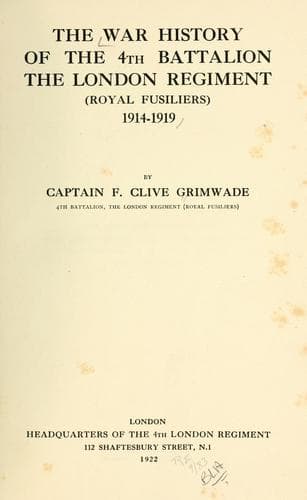
The War History of the 4th Battalion, the London Regiment (Royal Fusiliers), 1914-1919Grimwade, F. Clive
History
The War History of the 4th Battalion, the London Regiment (Royal Fusiliers), 1914-1919
Grimwade, F. Clive
Great Britain. Army. London Regiment. 4th (City of London) Battalion; World War, 1914-1918 -- Regimental histories -- Great Britain
At this time the Turkish Feast of Barram was proceeding, and when it
drew to a close on the evening of the 22nd it was anticipated with
some confidence that the enemy would attempt a demonstration against
the Allied positions. The only activity, however, was on our side and
our batteries both on land and sea gave the Turks a particularly hot
time during the evening. During this tour the weather began to break
and heavy rains fell, but apart from the wet condition of the trenches
and the consequent additional work in keeping them in repair the tour
of duty passed without incident of an unusual nature. On the 22nd half
the company officers and non-commissioned officers were attached for
instruction in the front line to the R.N. Battalions, their places
being taken after forty-eight hours by the other half.
On the 27th the 2nd Brigade returned to the line relieving the 1st
Brigade, which withdrew on relief to the Rest Camp, the 2/4th Londons
handing over their positions in the Eski line to the 2/2nd Londons.
This day General Sir Ian Hamilton handed over command-in-chief of the
Dardanelles Army to General Sir C. C. Monro, K.C.B. Sir Charles Monro's
duty on assuming command was in the first instance to report as to the
desirability, on purely military grounds, of evacuating the Peninsula,
and alternatively as to the force required to bring the campaign to
a successful issue. A reconnaissance of the position led him to the
conclusion that evacuation should be taken in hand, and the adoption
of this course received official approval, with results which will be
recorded in their place.
In the Rest Camp the Battalion spent six days, which were occupied in
work on new winter quarters and dugouts, and which passed quietly but
for heavy shelling on the 29th October and the 1st November from enemy
batteries on the Asiatic shore; but fortunately no casualties were
suffered.
The month of November was occupied in duty in and out of the line,
tours in the trenches being for seven days, followed by seven days in
the Rest Camp at Cape Helles. For both the tours in line the 2/4th
Londons were in reserve in the Eski lines though on each occasion
companies were sent in turn to the front trenches for instruction in
trench warfare. For this purpose they were attached to "Hawke," "Hood"
and "Drake" Battalions.
[Illustration: GALLIPOLI PENINSULA--CAPE HELLES TRENCHES, 1915]
The Turks at this period were comparatively quiet beyond a certain
amount of artillery fire, and for the companies in the Eski line the
time passed by no means unpleasantly. Engaged in strengthening and
improving the defences during working hours, they were allowed when
off duty to go in small parties down to Gully Beach on the Ægean
coast. These small excursions were the means of providing a change of
diet, for the men seldom returned without a good haul of fish, caught
by a stratagem in which, so rumour has it, the Mills Bomb figured
prominently.
Public-domain text, read in full here on John Shaqi.
Reviews
Reviews
No reviews yet
Be the first to share your thoughts on this work.
Elsewhere in the archive
Join the Discussion
Join the discussion
Sign in to leave a comment or review.
Sign InorCreate an account