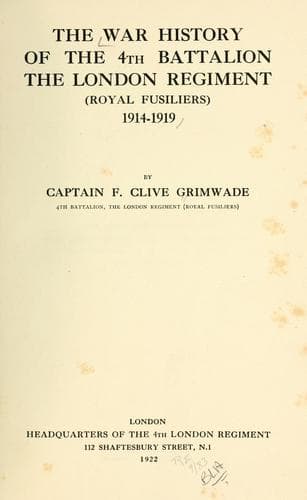
The War History of the 4th Battalion, the London Regiment (Royal Fusiliers), 1914-1919Grimwade, F. Clive
History
The War History of the 4th Battalion, the London Regiment (Royal Fusiliers), 1914-1919
Grimwade, F. Clive
Great Britain. Army. London Regiment. 4th (City of London) Battalion; World War, 1914-1918 -- Regimental histories -- Great Britain
The general scheme for the evacuation of the Helles front was similar
to that employed at Anzac and Suvla, and in the course of the second
stage of the operation, detachments of the 2/4th Londons, consisting
of 63 other ranks under Lieut. S. N. Davies and 50 other ranks under
2/Lieut. S. Davis were embarked for Mudros on the night of the 31st
December. These were followed the next night by 5 officers and 147
other ranks under Capt. R. N. Keen.
On the 3rd January 1916, the machine-guns of the Battalion, now
increased to six, were evacuated in charge of a N.C.O. and two men, and
on the following day the last battle casualties occurred, three men
being slightly wounded in the Rest Camp.
The preparations for final evacuation were now practically complete.
A strong embarkation staff had been formed to deal with the rapid
embarkation of the last troops as they should reach the beaches;
and new lines of defence guarding the beaches had been prepared for
occupation in case the enemy should become aware of the operation and
harass it.
On the night of the 6th/7th January, a fourth detachment of 4 officers
and 118 other ranks of the Battalion under Capt. Arthur left the
Peninsula, and the next night Major Seyd in command of the remainder
of the Battalion (8 officers and 155 other ranks) embarked at V Beach.
This completed the safe evacuation of the whole Battalion with the
exception of four men who were left behind attached to the "Dumeszyl
Battery" under Commander Alan Campbell, R.N.D. (since killed), for
demolition work. After completion of their hazardous duties all the
members of this brave unit were also safely embarked.
The total strength of the Battalion on evacuating the Peninsula
(including the transport and other details who had remained at Mudros
and Imbros) was 23 officers and about 560 other ranks. The total
casualties sustained at the hands of the enemy had been 2 officers
wounded, 16 N.C.O.'s and men killed and 38 wounded, the remaining
reduction of strength having been due to sickness and exposure.
On the 7th January the enemy opened an intense bombardment, said to be
the heaviest since the original landing in April 1915, on our trenches;
the shelling lasting from noon till 3.30 p.m., at which time two
Turkish mines were sprung near Fusilier Bluff. No attack developed
except at this point, where a half-hearted advance of the enemy was
easily dispersed.
Public-domain text, read in full here on John Shaqi.
Reviews
Reviews
No reviews yet
Be the first to share your thoughts on this work.
Elsewhere in the archive
Join the Discussion
Join the discussion
Sign in to leave a comment or review.
Sign InorCreate an account