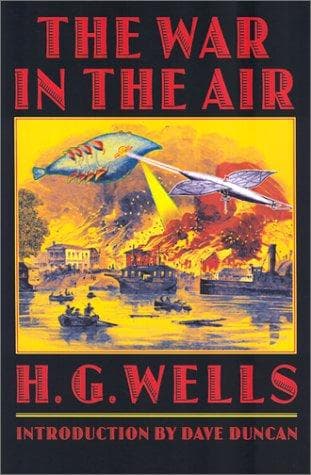
Air warfare -- Fiction; Science fiction; War stories
The special peculiarities of aerial warfare were of such a nature as
to trend, once it had begun, almost inevitably towards social
disorganisation. The first of these peculiarities was brought home
to the Germans in their attack upon New York; the immense power of
destruction an airship has over the thing below, and its relative
inability to occupy or police or guard or garrison a surrendered
position. Necessarily, in the face of urban populations in a state
of economic disorganisation and infuriated and starving, this led to
violent and destructive collisions, and even where the air-fleet floated
inactive above, there would be civil conflict and passionate disorder
below. Nothing comparable to this state of affairs had been known in
the previous history of warfare, unless we take such a case as that of
a nineteenth century warship attacking some large savage or barbaric
settlement, or one of those naval bombardments that disfigure the
history of Great Britain in the late eighteenth century. Then, indeed,
there had been cruelties and destruction that faintly foreshadowed the
horrors of the aerial war. Moreover, before the twentieth century the
world had had but one experience, and that a comparatively light one,
in the Communist insurrection of Paris, 1871, of the possibilities of a
modern urban population under warlike stresses.
A second peculiarity of airship war as it first came to the world that
also made for social collapse, was the ineffectiveness of the early
air-ships against each other. Upon anything below they could rain
explosives in the most deadly fashion, forts and ships and cities lay at
their mercy, but unless they were prepared for a suicidal grapple they
could do remarkably little mischief to each other. The armament of the
huge German airships, big as the biggest mammoth liners afloat, was one
machine gun that could easily have been packed up on a couple of mules.
In addition, when it became evident that the air must be fought for, the
air-sailors were provided with rifles with explosive bullets of oxygen
or inflammable substance, but no airship at any time ever carried as
much in the way of guns and armour as the smallest gunboat on the navy
list had been accustomed to do. Consequently, when these monsters met in
battle, they manoeuvred for the upper place, or grappled and fought like
junks, throwing grenades fighting hand to hand in an entirely medieval
fashion. The risks of a collapse and fall on either side came near to
balancing in every case the chances of victory. As a consequence, and
after their first experiences of battle, one finds a growing tendency on
the part of the air-fleet admirals to evade joining battle, and to seek
rather the moral advantage of a destructive counter attack.
Public-domain text, read in full here on John Shaqi.
Reviews
Reviews
No reviews yet
Be the first to share your thoughts on this work.
Elsewhere in the archive
Join the Discussion
Join the discussion
Sign in to leave a comment or review.
Sign InorCreate an account