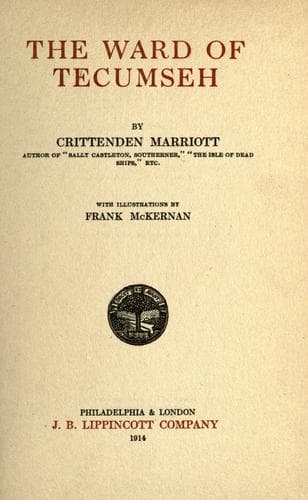
Indians of North America -- Wars -- 1812-1815 -- Fiction; United States -- History -- War of 1812 -- Fiction
“Your father left them,” he said. “Spend the money, but keep the
picture safe. Your father said it would prove your rights if need be.
Hang it around your neck by the chain and show it to no one till you
must. Now, farewell.”
CHAPTER VI
LITTLE sleep was there for any one in the Shawnee camp that night.
Hour after hour the witchdrums boomed and the leaping ghost fires
flamed to the far-off blinking stars. Hour after hour the thunderous
chanting of the braves shivered through the forest, waking the resting
birds and scaring the four-footed prowlers of the night. Hour after
hour the chiefs debated peace and war, now listening to the words of
the redcoat emissary of the British king, now hearkening to Tecumseh,
now turning ear to Catahecasa (Black Hoof) or to Wathethewela (Bright
Horn), as they spoke for peace, declaring that the British would fight
for a time and then go away, but that the Long Knives from the south
would stay forever. Hour after hour the wheeling stars, a silver dust
behind the chariot of the moon, rose, passed, and sank. Hour after hour
the mounting mists of the Black Swamp wavered and fell back, driven
away by the heat of the fires and the hot breaths of the warriors.
Dawn was breaking in the east as Tecumseh and his devoted few struck
their hatchets into the war post and left the council to prepare for
their northward venture, leaving the bulk of the Shawnees loyal to the
Seventeen Fires.
Long before this, Alagwa had sought Wabetha, wife of Tecumseh, and had
told her the will of the great chief. In the privacy of the lodge she
had dropped her Indian garments from her one by one, till she stood
revealed in the firelight, a slender shape amazingly fair compared
to the red tints of the Indians. Wabetha, softly marvelling over the
ever-new wonder of her white beauty, had hacked at the two heavy
plaits of burnished hair till they fell like two great snakes to the
trampled clay of the floor, leaving the girl bare indeed. Then, one by
one, she had clothed her in the unfamiliar garments of the whites, the
strong calico shirt, the deerskin knee breeches, the leggings wrapped
about each slender limb and bound at the top and at the bottom with
pliant thongs, the high moccasins padded as a protection against the
snakes that infested the whole region. When the squaw placed on her
head the inevitable coonskin cap of the white hunter, it would have
taken a sharp eye to suspect the sex of this Indian-trained daughter
of the Huguenots. Straight as a fir and supple as a willow, retaining
longer than most of her sex the slender lines of childhood, she hid all
feminine curves beneath the loose garb of the woodsman.
Public-domain text, read in full here on John Shaqi.
Reviews
Reviews
No reviews yet
Be the first to share your thoughts on this work.
Join the Discussion
Join the discussion
Sign in to leave a comment or review.
Sign InorCreate an account