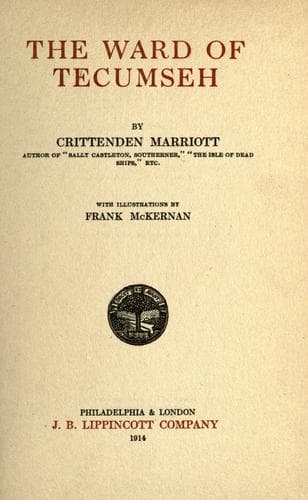
Indians of North America -- Wars -- 1812-1815 -- Fiction; United States -- History -- War of 1812 -- Fiction
When, with the first peep of dawn Wilwiloway came slipping through the
rolling mists to scratch at the cabin door, she was ready, her good-bys
said. Without a word she fell in at his heels and together they took
the long trail south, the trail whose only end, so far as known to her,
would be beneath alien stars at the borders of a sea unknown.
Wilwiloway moved cautiously. No sign of danger was visible, but he was
too well versed in the war trail not to know that the unseen danger is
ever the deadliest. Alagwa followed, also cautiously, not because she
feared, for she did not, but because she had been trained to obey the
will of the leaders. Close at Wilwiloway’s heels she trod, putting her
feet carefully into his footprints. Only once she paused, at the edge
of the clearing, and looked backward at the vast wavering draperies of
mist that hid the only home she could remember. Her eyes were dim and
her cheeks wet, not merely from the clinging fingers of the fog, as she
strove to penetrate the blanket of mist that hung before her. For a
moment she gazed, then, with a choking sob, she hurried on.
Hour after hour the two sped southward. Neither spoke. Wilwiloway, at
his great leader’s command, was giving up the hope of his life, and was
giving it up silently and stolidly, with Indian stoicism. Alagwa was
giving up all she had known, all her friends, all the familiar scenes
of her childhood.
And yet, after the first pang, her thoughts went forward, not backward,
ranging into the strange new world into which she was hurrying. Alagwa
was skilled in all forms of woodcraft; she could make fire where a
white man would freeze; catch game where he would starve; sleep warm
and snug where he would shiver and rack with wet and fever and ague.
She knew the forest trails, knew the rocks on which the rattlesnake
sunned and the tufts of grass beneath which the copperhead lurked,
knew the verdure that hid the quagmire, the firm-appearing ice that
splintered at a touch, the tottering tree that dealt ruin at a breath.
But of the white man’s ways she knew almost nothing. Before her
father died he had taught her to speak French, but in the years that
had passed since then she had nearly forgotten it. From one source
or another, from Colonel Johnson and his family, from two or three
prisoners, she had learned English--enough to understand if not enough
to speak fluently. But other than this she knew nothing--except that
there was a world of things to be known.
Public-domain text, read in full here on John Shaqi.
Reviews
Reviews
No reviews yet
Be the first to share your thoughts on this work.
Join the Discussion
Join the discussion
Sign in to leave a comment or review.
Sign InorCreate an account