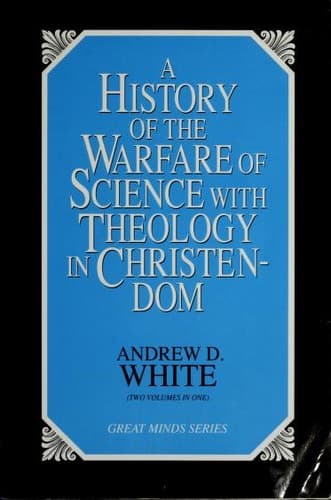
Religion and science; Religion and science -- History; Science -- History
The pope himself, Paul V., now intervenes; he orders that Galileo be
brought before the Inquisition. Then the great man of science in that
age is brought face to face with the greatest theologian: Galileo is
confronted by Cardinal Bellarmin. Bellarmin shows Galileo the error
of his opinion, and orders him to renounce it. De Lauda, fortified by
a letter from the pope, ordering the astronomer to be placed in the
dungeon of the Inquisition should he refuse to yield, commands him
to "_abandon entirely the opinion that the sun is the centre of the
universe, and that the earth moves_, and to abstain from sustaining,
teaching, or defending that opinion in any manner whatever, orally or
by writing."[50]
Galileo bowed to this order, was allowed to retire, and the whole
proceeding was kept secret.
About ten days later, on March 5, 1616, the Congregation of the Index,
moved thereto, as we have seen, and as the letters and documents now
brought to light show, by Pope Paul V., solemnly rendered their decree:
that the doctrine of the double movement of the earth about its axis
and about the sun is _false and entirely contrary to Holy Scripture_;
that this opinion must neither be taught nor defended. The same decree
condemned the writings of Kopernik, and _all writings which affirm
the motion of the earth_. The great work of Kopernik was interdicted
until corrected in accordance with the views of the Inquisition; and
the works of Galileo and Kepler, though not mentioned by name, were
included among those implicitly condemned as "affirming the motion of
the earth."
The condemnations were inscribed upon the _Index_, and to the Index was
prefixed the usual papal bull giving its monitions the papal sanction.
To teach or even read the works denounced or passages condemned, was to
risk persecution in this world and damnation in the next. Human science
had apparently lost the great decisive battle.
For some time Galileo remained at Rome perfectly submissive.[51] Pope
Paul V. petted him, and all seemed happy in the ending of the long war.
Public-domain text, read in full here on John Shaqi.
Reviews
Reviews
No reviews yet
Be the first to share your thoughts on this work.
Join the Discussion
Join the discussion
Sign in to leave a comment or review.
Sign InorCreate an account