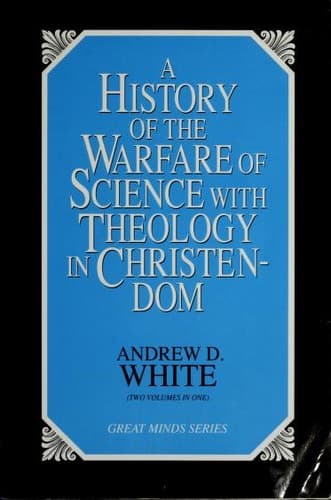
Religion and science; Religion and science -- History; Science -- History
But, returning to Florence, something of his old scientific ardor
stirred within him; and at last Cardinal Barberini, who had seemed
liberal and friendly, having been made pope under the name of Urban
VIII., Galileo conceived new hopes, and again in a published work
alluded favorably to the Copernican system. New troubles ensued.
Galileo was induced to visit Rome again, and Pope Urban tried to
cajole him into silence, and personally took the trouble to try to
show the astronomer his errors by argument. Other opponents were less
considerate. Works appeared attacking his ideas--works all the more
unmanly, since their authors knew how Galileo was restrained by force
from defending himself; and, as if to accumulate proofs of the fitness
of the Church to take charge of advanced instruction, his salary as
professor at the University of Pisa was taken from him. Sapping and
mining began. Just as the Archbishop of Pisa some years before had
tried to betray Galileo with honeyed words to the Inquisition, so now
Father Grassi tried it; and after various attempts to draw him out by
flattery, suddenly denounced his scientific ideas as "leading to a
denial of the real presence in the Eucharist."
And here science again loses ground. Galileo had announced his
intention of writing upon the theory of the tides, but he retreated,
and thus was lost a great treatise to the world.
For the final assault, the park of heavy artillery was at last wheeled
into place. You see it on all the scientific battle-fields. It consists
of general denunciation; and Father Melchior Inchofer, of the Jesuits,
brought his artillery to bear well on Galileo with this declaration:
that the opinion of the earth's motion is, of all heresies, the
most abominable, the most pernicious, the most scandalous; that the
immobility of the earth is thrice sacred; that argument against the
immortality of the soul, the Creator, the incarnation, etc., should be
tolerated sooner than an argument to prove that the earth moves.[52]
But this state of things could not be endured forever. Urged beyond
forbearance, Galileo prepares a careful treatise in the form of a
dialogue, exhibiting the arguments for and against the Copernican and
Ptolemaic systems. He then offers to submit to any conditions the
Church tribunals may impose, if they will but allow it to be printed.
At last they consent, imposing the most humiliating condition of all,
which was a preface written by Father Ricciardi and signed by Galileo,
in which the whole work was virtually exhibited as a play of the
imagination, and not at all as opposed to the truth laid down in 1616
by the Inquisition.
Public-domain text, read in full here on John Shaqi.
Reviews
Reviews
No reviews yet
Be the first to share your thoughts on this work.
Join the Discussion
Join the discussion
Sign in to leave a comment or review.
Sign InorCreate an account