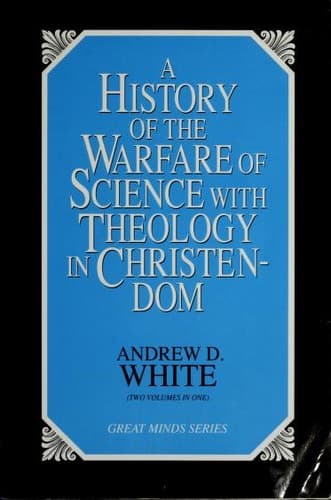
Religion and science; Religion and science -- History; Science -- History
On the other hand, what had science done for religion? Simply this:
Kopernik, escaping persecution only by death; Giordano Bruno, burned
alive as a monster of impiety; Galileo, imprisoned and humiliated as
the worst of misbelievers; Kepler, hunted alike by Protestant and
Catholic, had given to religion great new foundations, great new,
ennobling conceptions, a great new revelation of the might of God.
Under the old system we have that princely astronomer, Alfonso of
Castile, seeing the poverty of the Ptolemaic system, yet knowing no
other, startling Europe with the blasphemy that if he had been present
at creation he could have suggested a better ordering of the heavenly
bodies. Under the new system you have Kepler, filled with a religious
spirit, exclaiming, "I do think the thoughts of God."[84] The
difference in religious spirit between these two men marks the conquest
made in this, even by science, for religion.
But we cannot leave the subject of astronomy without noticing the most
recent warfare. Especially interesting is it because at one period the
battle seemed utterly lost, and then was won beautifully, thoroughly,
by a legitimate advance in scientific knowledge. I speak of the Nebular
Hypothesis.
The sacred writings of the Jews which we have inherited speak literally
of the creation of the heavenly bodies by direct intervention, and for
the convenience of the earth. This was the view of the Fathers of the
Church, and was transmitted through the great doctors in theology.
More than that, it was crystallized in art. So have I seen, over the
portal of the Cathedral of Freiburg, a representation of the Almighty
making and placing numbers of wafer-like suns, moons, and stars; and at
the centre of all, platter-like and largest of all, the earth.[85] The
lines on the Creator's face show that He is obliged to contrive; the
lines of his muscles show that He is obliged to toil. Naturally, then,
did sculptors and painters of the mediæval and early modern period
represent the Almighty as weary after labor, and enjoying dignified
repose.
These ideas, more or less gross in their accompaniments, passed into
the popular creed of the modern period.
But about the close of the last century, Bruno having guessed the
fundamental fact of the nebular hypothesis, and Kant having reasoned
out its foundation idea, Laplace developed it, showing the reason for
supposing that our own solar system, in its sun, planets, satellites,
with their various motions, distances, and magnitudes, is a natural
result of the diminishing heat of a nebulous mass--a result obeying
natural laws.
Public-domain text, read in full here on John Shaqi.
Reviews
Reviews
No reviews yet
Be the first to share your thoughts on this work.
Join the Discussion
Join the discussion
Sign in to leave a comment or review.
Sign InorCreate an account