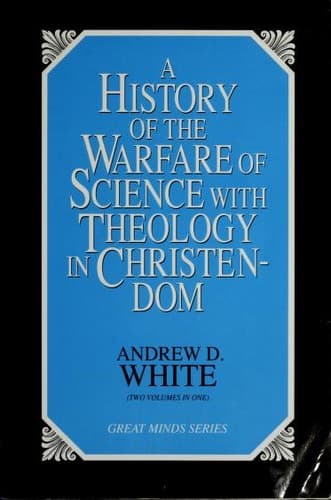
Religion and science; Religion and science -- History; Science -- History
There was an outcry at once against the "atheism" of the scheme. The
war raged fiercely. Laplace claimed that there were in the heavens
many nebulous patches yet in the gaseous form, and pointed them out.
He showed by laws of physics and mathematical demonstration that his
hypothesis accounted in a most striking manner for the great body of
facts, and, despite clamor, was gaining ground, when the improved
telescopes resolved some of the patches of nebulous matter into
multitudes of stars.
The opponents of the nebular hypothesis were overjoyed; they sang
pæans to astronomy, because, as they said, it had proved the truth of
Scripture. They had jumped to the conclusion that all nebulæ must be
alike--that if _some_ are made up of systems of stars, _all_ must be so
made up; that none can be masses of attenuated gaseous matter, because
some are not.
Science, for a time, halted. The accepted doctrine became this: that
the only reason why all the nebulæ are not resolved into distinct
stars is because our telescopes are not sufficiently powerful. But in
time came that wonderful discovery of the spectroscope and spectrum
analysis, and this was supplemented by Fraunhofer's discovery that the
spectrum of an ignited gaseous body is discontinuous, with interrupting
lines; and this, in 1846, by Draper's discovery that the spectrum of an
ignited solid is continuous, with no interrupting lines. And now the
spectroscope was turned upon the nebulæ, and about one-third of them
were found to be gaseous.
Again the nebular hypothesis comes forth stronger than ever. The
beautiful experiment of Plateau on the rotation of a fluid globe comes
in to strengthen if not to confirm it. But what was likely to be lost
in this? Simply a poor conception of the universe. What to be gained? A
far more worthy idea of that vast power which works in the universe, in
all things by law, and in none by caprice.[86]
CHEMISTRY AND PHYSICS.
The great series of battles to which I next turn with you were fought
on those fields occupied by such sciences as Chemistry and Natural
Philosophy.
Even before these sciences were out of their childhood, while yet they
were tottering mainly toward childish objects and by childish steps,
the champions of that same old mistaken conception of rigid Scriptural
interpretation began the war. The catalogue of chemists and physicists
persecuted or thwarted would fill volumes.
The first entrance of these sciences, as a well-defined force, into
the modern world, began in the thirteenth century. But the thirteenth
century was marked by a revival of religious fervor; to this day the
greatest and best works of the cathedral-builders are memorials of its
depth and strength.
Out of this religious fervor naturally came a great growth of
theological thought and ecclesiastical power, and the spirit of inquiry
was soon obliged to take account of this influence.
Public-domain text, read in full here on John Shaqi.
Reviews
Reviews
No reviews yet
Be the first to share your thoughts on this work.
Join the Discussion
Join the discussion
Sign in to leave a comment or review.
Sign InorCreate an account