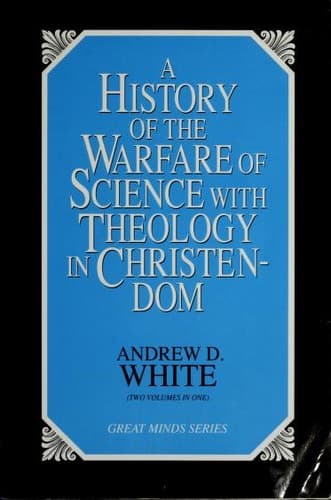
Religion and science; Religion and science -- History; Science -- History
One statement more, to clear the ground. You will not understand me at
all to say that religion has done nothing for science. It has done much
for it. The work of Christianity has been mighty indeed. Through these
two thousand years, despite the waste of its energies on all the things
its Blessed Founder most earnestly condemned--on fetich and subtlety
and war and pomp--it has undermined servitude, mitigated tyranny, given
hope to the hopeless, comfort to the afflicted, light to the blind,
bread to the starving, joy to the dying, and this work continues. And
its work for science, too, has been great. It has fostered science
often. Nay, it has nourished that feeling of self-sacrifice for human
good, which has nerved some of the bravest men for these battles.
Unfortunately, a devoted army of good men started centuries ago with
the idea that independent scientific investigation is unsafe--that
theology must intervene to superintend its methods, and the Biblical
record, as an historical compendium and scientific treatise, be taken
as a standard to determine its results. So began this great modern war.
GEOGRAPHY.
The first typical battle-field to which I would refer is that of
Geography--the simplest elementary doctrine of the earth's shape and
surface.
Among the legacies of thought left by the ancient world to the modern,
were certain ideas of the rotundity of the earth. These ideas were
vague; they were mixed with absurdities; but they were _germ ideas_,
and, after the barbarian storm which ushered in the modern world had
begun to clear away, these germ ideas began to bud and bloom in the
minds of a few thinking men, and these men hazarded the suggestion that
the earth is round--is a globe.[1]
The greatest and most earnest men of the time took fright at once. To
them, the idea of the earth's rotundity seemed fraught with dangers to
Scripture: by which, of course, they meant _their interpretation_ of
Scripture.
Among the first who took up arms against the new thinkers was Eusebius.
He endeavored to turn off these ideas by bringing science into
contempt, and by making the innovators understand that he and the
fathers of the Church despised all such inquiries. Speaking of the
innovations in physical science, he said: "It is not through ignorance
of the things admired by them, but through contempt of their useless
labor, that we think little of these matters, turning our souls to
better things."[2]
Lactantius asserted the ideas of those studying astronomy to be "mad
and senseless."[3]
Public-domain text, read in full here on John Shaqi.
Reviews
Reviews
No reviews yet
Be the first to share your thoughts on this work.
Join the Discussion
Join the discussion
Sign in to leave a comment or review.
Sign InorCreate an account