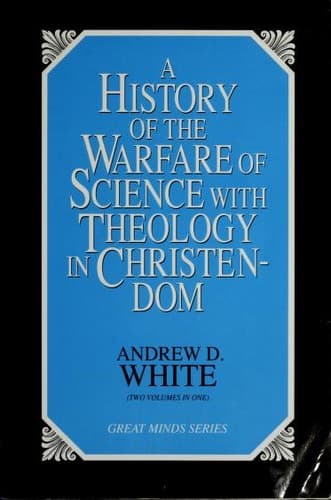
Religion and science; Religion and science -- History; Science -- History
But the attempt to "flank" the little phalanx of thinkers did not
succeed, of course. Even such men as Lactantius and Eusebius cannot
pooh-pooh down a new scientific idea. The little band of thinkers went
on, and the doctrine of the rotundity of the earth naturally led to the
consideration of the tenants of the earth's surface, and another germ
idea was warmed into life--the idea of the existence of the antipodes,
the idea of the existence of countries and men on the hemisphere
opposite to ours.[4]
At this the war-spirit waxed hot. Those great and good men determined
to fight. To all of them such doctrines seemed dangerous; to most of
them they seemed damnable. St. Basil and St. Ambrose[5] were tolerant
enough to allow that a man might be saved who believed the earth to be
round, and inhabited on its opposite sides; but the great majority of
the Fathers of the Church utterly denied the possibility of salvation
to such misbelievers.
Lactantius asks: "... Is there any one so senseless as to believe that
there are men whose footsteps are higher than their heads?--that the
crops and trees grow downward?--that the rains and snow and hail fall
upward toward the earth?... But if you inquire from those who defend
these marvelous fictions, why all things do not fall into that lower
part of the heaven, they reply that such is the nature of things, that
heavy bodies are borne toward the middle, like the spokes of a wheel;
while light bodies, such as clouds, smoke, and fire, tend from the
centre toward the heavens on all sides. Now, I am at loss what to say
of those who, when they have once erred, steadily persevere in their
folly, and defend one vain thing by another."
St. Augustine seems inclined to yield a little in regard to the
rotundity of the earth, but he fights the idea that men exist on the
other side of the earth, saying that "Scripture speaks of no such
descendants of Adam."
But this did not avail to check the idea. What may be called the flank
movement, as represented by Eusebius, had failed. The direct battle
given by Lactantius, Augustine, and others, had failed; in the sixth
century, therefore, the opponents of the new ideas built a great
fortress and retired into that. It was well built and well braced. It
was nothing less than a complete theory of the world, based upon the
literal interpretation of texts of Scripture, and its author was Cosmas
Indicopleustes.[6]
According to Cosmas, the earth is a parallelogram, flat, and surrounded
by four great seas. At the outer edges of these seas rise immense walls
closing in the whole structure. These walls support the vault of the
heavens, whose edges are cemented to the walls; walls and vault shut
in the earth and all the heavenly bodies. The whole of this theologic,
scientific fortress was built most carefully, and, as was then thought,
most scripturally.
Public-domain text, read in full here on John Shaqi.
Reviews
Reviews
No reviews yet
Be the first to share your thoughts on this work.
Join the Discussion
Join the discussion
Sign in to leave a comment or review.
Sign InorCreate an account