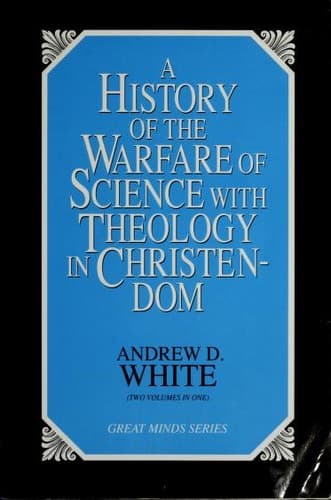
Religion and science; Religion and science -- History; Science -- History
Vincent devoted himself to the study of Nature in several of her most
interesting fields. To astronomy, mineralogy, botany, and chemistry,
he gave much thought; but especially did he devote himself to the
preparation of a full account of the universe. Had he taken the path
of experimental research, the world would have been enriched with most
precious discoveries; but the impulse followed by Albert of Bollstadt,
backed as it was by the whole ecclesiastical power of his time, was
too strong, and, in all the life-labor of Vincent, nothing appears of
any permanent value. He built a structure which careless observation
of facts, literal interpretation of Scripture, and theological
subtilizing, combined to make one of the most striking monuments of
human error.[89]
But the theological ecclesiastical spirit of the thirteenth century
gained its greatest victory in the work of the most renowned of all
thinkers of his time, St. Thomas Aquinas. In him was the theological
spirit of his age incarnate. Although he yielded somewhat, at one
period, to love of studies in natural science, it was he who finally
made that great treaty or compromise which for ages subjected science
entirely to theology. He it was whose thought reared the most enduring
barrier against those who, in that age and in succeeding ages, labored
to open for science the path by its own legitimate method toward its
own noble ends.
Through the earlier systems of philosophy as they were then known,
and through the earlier theologic thought, he had gone with great
labor and vigor; he had been a pupil of Albert of Bollstadt, and from
him had gained inspiration in science. All his mighty powers, thus
disciplined and cultured, he brought to bear in making a treaty or
truce, giving to theology the supremacy over science. The experimental
method had already been practically initiated; Albert of Bollstadt and
Roger Bacon had begun their work in accordance with its methods; but
St. Thomas Aquinas gave all his thoughts to bringing science again
under the sway of the theological bias, metaphysical methods, and
ecclesiastical control. He gave to the world a striking example of what
his method could be made to produce. In his commentary upon Aristotle's
treatise upon "Heaven and Earth" he illustrates all the evils of such
a combination of theological reasoning and literal interpretation of
the Scriptural with scientific facts as then understood, and it remains
to this day a prodigious monument to human genius and human folly.
The ecclesiastical power of the time hailed him as a deliverer; it
was claimed that striking miracles were vouchsafed, showing that the
blessing of Heaven rested upon his labors. Among the legends embodying
the Church spirit of that period is that given by the Bollandists and
immortalized by a renowned painter. The great philosopher and saint
is represented in the habit of his order, with book and pen in hand,
kneeling before the image of Christ crucified; and as he kneels the
Public-domain text, read in full here on John Shaqi.
Reviews
Reviews
No reviews yet
Be the first to share your thoughts on this work.
Join the Discussion
Join the discussion
Sign in to leave a comment or review.
Sign InorCreate an account