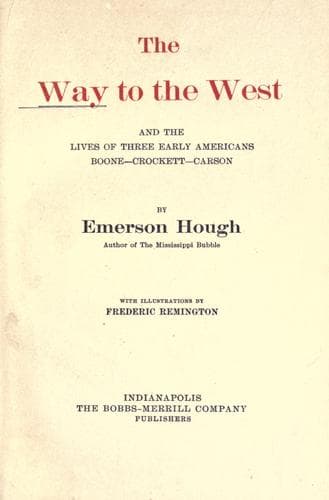
The Way to the West, and the Lives of Three Early Americans: Boone—Crockett—CarsonHough, Emerson
History
The Way to the West, and the Lives of Three Early Americans: Boone—Crockett—Carson
Hough, Emerson
Boone, Daniel, 1734-1820; Carson Kit, 1809-1868; Crockett, Davy, 1786-1836; Mississippi River Valley -- History; West (U.S.) -- History
“The journey required thirty-one days of continuous staging, and was
prolonged by delays occasioned by the incursions of the hostile Sioux,
who had killed several stock-tenders at different stations, burned the
buildings, and stolen the horses. From their frequent attacks upon the
coaches it was necessary for us to be on the constant outlook. On the
second day after leaving Atchison, the eastern-bound coach met us,
having on board one wounded passenger, the next day with one dead, and
the next with another wounded. At Sand Hill station the body of the
station keeper was lying by the side of the smoking ruins of the log
cabin. As there was no stock to be found for a change of horses, we
drove on with our worn-out team, at a slow pace, to the next station.
The reports of passengers eastern-bound were also very discouraging. Yet
this risk of life did not lessen travel. The coaches were generally
full. The fare from Atchison to Helena was four hundred and fifty
dollars, and our meals cost each of us upward of one hundred and fifty
dollars more.”
These preliminary statements as to the difficulties and dangers of the
early transportation will make plainer the somewhat extraordinary prices
of merchandise that often ruled. Thus, on December thirty-first, 1864,
one will see coal oil quoted in the market reports of Virginia City,
Montana, at nine to ten dollars per gallon. On January twenty-eighth,
1865, we read: “Candles: less active in consequence of the decline in
coal oil.” Then comes, “Coal oil, nine dollars; linseed oil, ten
dollars.” At the head we read that these market quotations are wholesale
prices for gold, and that ten per cent. should be added for retail
prices. At the bottom we have greenback quotations for gold dust and
gold coin, showing that greenbacks were worth not quite forty-five cents
on the dollar for gold coin. Even this was more than they were worth in
the States, with gold at two twenty-five. Coal oil at nine dollars a
gallon in gold, with greenbacks at forty-five cents, would cost twenty
dollars a gallon in greenbacks, at wholesale. Add ten per cent., and we
have twenty-two dollars as the retail price. Linseed oil at ten dollars
a gallon in gold would be twenty-four dollars and twenty cents a gallon
in greenbacks, at retail.
[Illustration: A VOYAGEUR.]
In the issue of the Post of April twenty-second, 1865, flour was quoted
at eighty-five dollars a sack of one hundred pounds on April
seventeenth, and it is stated that on April nineteenth, within a few
hundred miles, it had sold for five dollars a pound. This was just after
the surrender of Lee’s army, when greenbacks were selling for ninety
cents for gold dust, and at eighty-two (eight per cent. less) for coin.
This was over six dollars a pound for flour, or twelve hundred dollars
for a barrel!
Public-domain text, read in full here on John Shaqi.
Reviews
Reviews
No reviews yet
Be the first to share your thoughts on this work.
Elsewhere in the archive
Join the Discussion
Join the discussion
Sign in to leave a comment or review.
Sign InorCreate an account