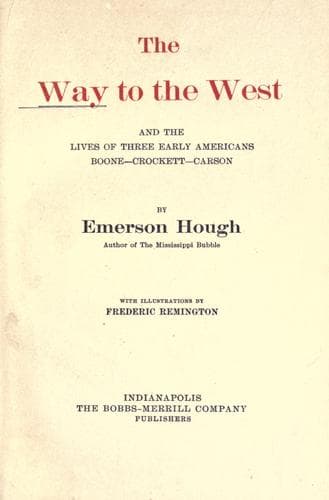
The Way to the West, and the Lives of Three Early Americans: Boone—Crockett—CarsonHough, Emerson
History
The Way to the West, and the Lives of Three Early Americans: Boone—Crockett—Carson
Hough, Emerson
Boone, Daniel, 1734-1820; Carson Kit, 1809-1868; Crockett, Davy, 1786-1836; Mississippi River Valley -- History; West (U.S.) -- History
On April twenty-ninth, 1865, potatoes were worth forty to fifty cents a
pound in gold. At an average price of forty-five cents a pound, a bushel
(seventy pounds) cost thirty-eight dollars in greenbacks. On May sixth
we read: “Potatoes. Several large loads have arrived, . . . causing a
decline of five cents a pound.” So potatoes dropped off in price, in one
day, four dollars in greenbacks per bushel.
“On May thirteenth,” comments Mr. Langford further, regarding this
interesting commercial situation, “we note that the principal
restaurant, ‘in consequence of the recent fall in flour,’ reduced day
board to twenty dollars per week for gold. The food of this restaurant
was very plain, and dried-apple pies were considered a luxury. At that
time I was collector of internal revenue, and received my salary in
greenbacks. I paid thirty-six dollars per week for day board at the
Gibson House, at Helena. During the period of the greatest scarcity of
flour, the more common boarding houses posted the following signs:
‘Board with bread at meals, $32; board without bread, $22; board with
bread at dinner, $25.’ Those who took bread at each meal paid about ten
dollars per week more than those who took none.”
Here is the story of an incipient bread riot in the ancient West of
thirty-five years ago, taken from the columns of the journal previously
mentioned:
“VIRGINIA CITY, MONTANA, April 22, 1865.
“April 16. The flour market opened at an advance of ten dollars per
sack, and by eleven o’clock A. M. had reached the nominal price of
sixty-five dollars per ninety-eight-pound sack. The day closing, holders
asked a further advance of five dollars per sack.
“April 17. The demand for flour is increasing. The market opened firm at
yesterday’s prices. Before ten o’clock it had advanced to seventy-five
dollars per sack. Eleven o’clock rolls round and finds dealers in this
staple asking eighty dollars per ninety-eight-pound sack. A few
transactions were made at these figures. Before twelve o’clock transfers
were made at eighty-five dollars per sack, and some few dealers were
asking a further advance of five dollars per sack. Consumers, having no
other resource, were compelled to concede to the nominal price of
holders, and paid ninety dollars per sack in gold.
“April 18. Flour is truly on the rampage, no concession from dealers’
prices on the part of the very few holders of considerable quantities,
with a still further advance of five dollars per sack, which brings the
price of an average lot of flour to the unprecedented figures, in this
market, of one dollar per pound.
“April 19. The flour market weakened under the excitement of ‘current
reports’ from some new speculators in the market, transfers of small
lots being made at eighty dollars per sack.
“Eleven o’clock. Our city is thrown into a state of excitement. Rumors
of a bread riot are heard from all quarters.
Public-domain text, read in full here on John Shaqi.
Reviews
Reviews
No reviews yet
Be the first to share your thoughts on this work.
Elsewhere in the archive
Join the Discussion
Join the discussion
Sign in to leave a comment or review.
Sign InorCreate an account