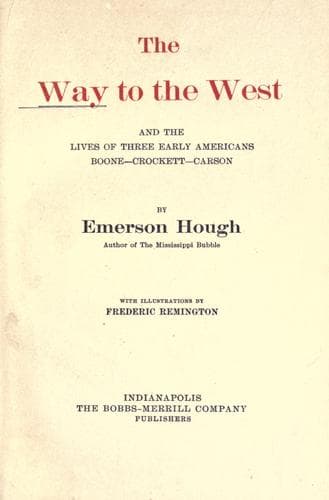
The Way to the West, and the Lives of Three Early Americans: Boone—Crockett—CarsonHough, Emerson
History
The Way to the West, and the Lives of Three Early Americans: Boone—Crockett—Carson
Hough, Emerson
Boone, Daniel, 1734-1820; Carson Kit, 1809-1868; Crockett, Davy, 1786-1836; Mississippi River Valley -- History; West (U.S.) -- History
“Twelve o’clock. Our principal streets are well lined and coated with
men, avowedly on the raid for flour.
“Later. Flour is seized wherever found, in large or small quantities,
and taken to a common depot. On the pretext under which several lots of
flour were confiscated, we do not think that any one would consider it
wrong or objectionable to store flour, under the present circumstances,
in fire-proof cellars or warehouses.
“We, however, do not indorse the concealing of flour under floors or
haystacks when the article is up to the present price. We know of no
parties that were holders of flour that could not have realized a
handsome profit at seventy-five dollars per sack; but in favor of
merchants that have invested in this staple at high figures, we should
state that we have known flour to be sold within a circumference of a
few hundred miles at the rate of five dollars per pound, and no raiders
in the market.”
“VIRGINIA CITY, M. T., May 6, 1865.
“The business of the week is a slight improvement over many weeks past,
owing to the fine weather sending miners all to work.
“Flour. Still continues very scarce, three small lots, only one hundred
and twenty-one sacks in all, having arrived from over the range, and
were rapidly sold at seventy-five dollars per sack. The want of this
staple is very much felt, as all substitutes for this article are about
exhausted.”
These curious and rapidly forgotten records of another day show us
clearly that, even as late as the Civil War, there was a vast land
beyond the Missouri whose people and whose customs were different from
those of the East; which had earned its own right to be different; which
was as strong and self-reliant and resourceful as though it were part of
another sphere; and which might claim that it had solved its own
problems for itself and asked no aid. Yet it was this very aloofness and
independence that had always threatened, in one way or another, the
secession of the West in fact or in sympathy from the East. Therefore we
count that a great day—a day fatal for the West, but glorious for
America—when the heads of the streams were reached and the mountains
overrun. It was a great day, an important date—though unrecorded in any
history of this land—when the West had gone as far away as it could,
and at last had turned and begun to come back home!
At the end of the Civil War the West had exhausted all the possibilities
of down-stream and up-stream transportation. It had developed its
resources to a remarkable degree. But now the time was come for newer,
more rapid, and more revolutionary methods. The West was at the
beginning of another and not less interesting era, a time of swift and
startling change.
Public-domain text, read in full here on John Shaqi.
Reviews
Reviews
No reviews yet
Be the first to share your thoughts on this work.
Elsewhere in the archive
Join the Discussion
Join the discussion
Sign in to leave a comment or review.
Sign InorCreate an account