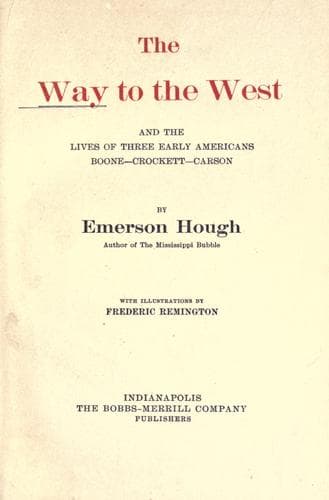
The Way to the West, and the Lives of Three Early Americans: Boone—Crockett—CarsonHough, Emerson
History
The Way to the West, and the Lives of Three Early Americans: Boone—Crockett—Carson
Hough, Emerson
Boone, Daniel, 1734-1820; Carson Kit, 1809-1868; Crockett, Davy, 1786-1836; Mississippi River Valley -- History; West (U.S.) -- History
In time the party turned up at Santa Fé, reaching that city in April,
1830, where the leader, Young, disposed of his furs, the net result for
eighteen men during a term of one year being twenty-four thousand
dollars. Kit Carson was now twenty-one years of age, and he was fully
initiated in his calling. We can not appreciate these journeyings except
by taking an accurate map of the great Western country, and following,
finger by finger, along stream and across mountain, the course of the
early voyagers.
This, however, is but the beginning. In the fall of 1830 the noted
Western fur trader, Fitzpatrick, organized a strong party, and it was
matter of course that Carson would find his way into it. This band
visited the Platte River, whose long southern arm reaches so deep down
into the heart of the Rockies. Thence, along good beaver waters, they
moved over to the Green River, Pacific waters, also historic in the fur
trade. We find them later in Jackson’s Hole, east of the range, even
today the center of a great game country. Thence they moved west to the
Salmon River, into a country still one of the wildest parts of America;
and there, much as a matter of fact, they joined others of their party,
who had started out slightly in advance of them, and “for whom they had
been looking,” as one chronicler naïvely advises us. It was a search and
a meeting in the heart of a wilderness many hundreds of miles in extent.
The winter of 1830-1831 was spent by Carson on the Salmon River. Now
enter those stern warriors of the North, the Blackfeet. Kit saw four of
his companions killed. He was inured to such scenes, and the incident
gave him no pause. April of 1831 found him on the Bear River. Moving,
always moving, we see him now on the Green River, again in the “New
Park” of Colorado, on the plains of Laramie, again on the long South
Fork of the Platte, and presently on the Arkansas. Beseech you, let your
finger ever follow on the map; and accept warrant that if your following
has been honest, your eyes shall stare in wonder at these journeyings.
Let one seek to duplicate it himself, even in these civilized days when
towns and ranches crowd the West; and then, having restored that West to
the day of beaver and Blackfeet, ask himself how had it been with him
had he been in Carson’s company!
This winter camp on the Arkansas River furnished a certain amount of
interest. A party of fifty Crow Indians raided the camp and stole a
number of horses. It was Carson once more, we may be sure, who was
elected to lead the pursuit. Twelve Indians were killed by the young
leader and his hardy riflemen. Carson was now accepted as one of the
captains of the trails. He had fully learned his bold and difficult
trade.
Public-domain text, read in full here on John Shaqi.
Reviews
Reviews
No reviews yet
Be the first to share your thoughts on this work.
Elsewhere in the archive
Join the Discussion
Join the discussion
Sign in to leave a comment or review.
Sign InorCreate an account