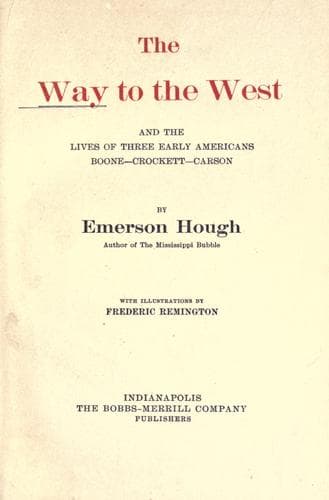
The Way to the West, and the Lives of Three Early Americans: Boone—Crockett—CarsonHough, Emerson
History
The Way to the West, and the Lives of Three Early Americans: Boone—Crockett—Carson
Hough, Emerson
Boone, Daniel, 1734-1820; Carson Kit, 1809-1868; Crockett, Davy, 1786-1836; Mississippi River Valley -- History; West (U.S.) -- History
In the spring of 1832 Carson’s party moved to the Laramie River; moved
again to the headwaters of the South Fork of the Platte, and caught
beaver and fought Indians for a few months; from the Laramie to the
Bayou Salade, or Ballo Salade, as it was sometimes spelled in those
days. These operations were carried on in the heart of the most
dangerous Indian country of the West. Heretofore it had been the custom
of the trappers to go in parties of considerable size, so that they
might successfully meet the Indians, who even thus made affairs
dangerous enough. The quality of Carson’s spirit may therefore be seen
when we discover him, with only two companions, breaking away for a
solitary beaver hunt in the mountains in the heart of the range. Yet
these three were fortunate, and returned to Taos in the fall of 1832
well laden with furs.
At Taos, Carson met Captain Lee of the United States Army, a partner of
that Bent who founded Bent’s Fort on the Arkansas. Captain Lee had a
cargo of goods that he wished to take to the rendezvous of the trapping
bands for that year. Kit joined him for the time, and in October of 1832
they pushed on, traveling part of the time on the old Spanish trail to
California. They reached the White River, the Green River, the “Windy”
River, and here, as though by special plan, they met their band of
trappers, erected their skin lodges, and passed the winter. Kit joined
the Fitzpatrick party for a time in the next spring, but after his own
restless fashion broke away again, with only three companions.
In the summer of 1833 we find the four on the Laramie River, doing
independent trapping and taking their chances as to Indians. It was
about this time that Kit had his historic adventure with two bears,
which chased him up a tree, and which he repelled by beating them over
the noses with a branch broken from the tree. The ever-wise biographer
Abbott, who gravely informs us that Crockett killed “voracious grizzly
bears” in the cane-brakes of Tennessee, with equal accuracy advises us
that the “grizzly bear can climb a tree as well as a man.” Herein we
find some mystery about Carson’s bear adventure. Carson as a hunter
would have been the first to know that a grizzly bear can not climb a
tree unless it be a horizontal one. There is no doubt, however, that
some such adventure took place with some sort of bears, and that Carson
saved his leggings if not his life by a knowledge of the tenderness of a
bear’s nose.
Public-domain text, read in full here on John Shaqi.
Reviews
Reviews
No reviews yet
Be the first to share your thoughts on this work.
Elsewhere in the archive
Join the Discussion
Join the discussion
Sign in to leave a comment or review.
Sign InorCreate an account