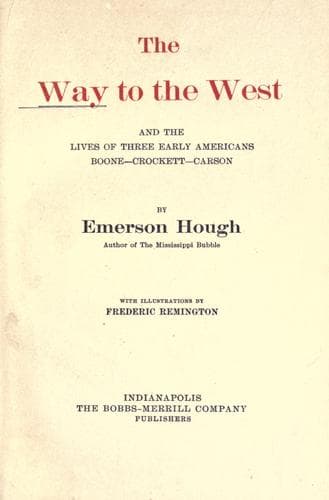
The Way to the West, and the Lives of Three Early Americans: Boone—Crockett—CarsonHough, Emerson
History
The Way to the West, and the Lives of Three Early Americans: Boone—Crockett—Carson
Hough, Emerson
Boone, Daniel, 1734-1820; Carson Kit, 1809-1868; Crockett, Davy, 1786-1836; Mississippi River Valley -- History; West (U.S.) -- History
All this time our Westerner, our trapper, is fitting himself for his
work in the West as guide for “explorers.” We find him with fifty men,
pushing up quite to the headwaters of the Missouri River, and later he
and some companions turn up along the historic Yellowstone River, a
country then well known in the organized fur trade of St. Louis. We do
not discover that he ever went into the regular employ of any of the fur
traders. No engagé or ordinary “pork eater” he, but a companion nearly
always of these independent fur traders, the individual gentry of the
wilderness. We find him now becoming acquainted with the Big Horn. He
knows also the three forks of the Missouri; and he visits the “Big
Snake” River and the Humboldt River, then called Mary’s River, since
scientists still were scarce in the Rockies.
He wanders continually back and forth across the upper Rockies. Brown’s
Hole, Jackson’s Hole, Henry Lake, the Black Hills, all the upper waters
of the great rivers, the Columbia, the Snake, the Green, the Colorado,
the Platte, the Missouri, the Yellowstone, the Arkansas,—you shall
hardly name any well-known Western region, any remote mountain park, any
accurately mapped Western stream which you shall not, providing you have
faithfully followed the wanderings of Kit Carson, discover to have been
familiar to this man even before geographies were dreamed of west of the
Missouri River.
It would be but wearying to go on with the monotonous chronicle of
repeated journeys back and forth, of hardships, of toils and dangers, of
the round of the trapper’s employment, of the wild life at those wild,
strange annual markets of the mountains, the trappers’ rendezvous. It
will suffice us and serve us to remember that Carson practically closed
his life as a trapper in 1834,[28] this date marking the end of eight
years steadily employed by him in trapping and trading and in learning
the West. In 1834 he and such companions as Bill Williams, William New,
Mitchell, Frederick, and scores of others of his old-time friends, found
themselves practically without a calling. When, after one long
expedition west of the range, they readied Fort Roubidoux, it was only
to discover that furs had gone very low in price.
The advent of the silk hat had caused terror in St. Louis, and gloom
throughout the Rockies. The day of the beaver trade was at an end. That
animal, of so monstrous an importance in the history of the American
continent, was now to assume a place far lower in estimation. Our bold,
befringed mountaineers learned that it would no longer pay to pursue it
into the remote fastnesses of the Rocky Mountains. Yet the beaver had
served its purpose. Following its tooth-marks on the trees, there had
pressed on to the head of every Western river a man qualifying for
office as guide of the west-bound civilization beyond the Missouri. Kit
Carson, type of the graduated trapper and adventurer, had had his
schooling.
Public-domain text, read in full here on John Shaqi.
Reviews
Reviews
No reviews yet
Be the first to share your thoughts on this work.
Elsewhere in the archive
Join the Discussion
Join the discussion
Sign in to leave a comment or review.
Sign InorCreate an account