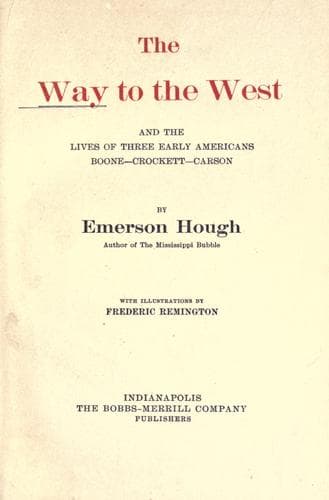
The Way to the West, and the Lives of Three Early Americans: Boone—Crockett—CarsonHough, Emerson
History
The Way to the West, and the Lives of Three Early Americans: Boone—Crockett—Carson
Hough, Emerson
Boone, Daniel, 1734-1820; Carson Kit, 1809-1868; Crockett, Davy, 1786-1836; Mississippi River Valley -- History; West (U.S.) -- History
Yet a man must live, and if there be no price for beaver peltry he must
turn his hand to something else for occupation. For eight years Kit
Carson served as hunter for the post, well-known as Bent’s Fort, on the
Arkansas River. There he fed forty men on the wild meat of the plains,
and during his eight years of hunting killed thousands of buffalo, elk,
and deer. He saw the plains in all their ancient undimmed splendor, and
whether he most loved the mountains or the plains he himself never could
tell. Carson at an earlier time had married an Indian girl, and during
his engagement at Fort Bent he sent his one child, a daughter, to St.
Louis for the purpose of acquiring an education. There the daughter
married, went to California, and apparently passes from the scene.
Carson’s later marriage was with a Mexican woman very much younger than
himself.[29]
If in the year 1834 Carson terminated the first term of his
Wanderschaft, in 1842, when he closed his first engagement as hunter for
Bent’s Fort, he completed the second season of his Western life and was
ready for the third. In that year he joined a wagon train bound
eastward, having determined to revisit his old home in Missouri, which
he had not seen for sixteen years. The visit was sad and cheerless
enough. He returned to find his parents dead and forgotten, the old
homestead in ruins, and not a friend left to take him by the hand.
He hastened thence to St. Louis, but ten days of even the capital of the
fur trade proved sufficient for him. Soon afterward, as is stated by his
most reliable biographer, he by mere chance met young Frémont, then
bound West to “explore” the Rocky Mountains, more especially that part
of the Rockies in the vicinity of the South Pass. Frémont’s guide did
not materialize at the time, and Carson’s modestly proffered services
were engaged by the army officer, who needed a guide across country,
which to many a Western man was as familiar as his own dooryard.[30]
During his first expedition Carson does not seem to have been much
valued by Frémont. Basil Lajeunesse was the favorite, and it was always
Basil Lajeunesse here, there, and everywhere; Carson, a man of much
greater experience and reliability, having not as yet come into his own
as a guide, though forsooth there was small need of guiding on this
journey. Frémont engaged Carson at one hundred dollars a month, and he
was the twenty-eighth man in the party, which also included two boys,
young relatives, who after all were not in so very dangerous an
enterprise.
Public-domain text, read in full here on John Shaqi.
Reviews
Reviews
No reviews yet
Be the first to share your thoughts on this work.
Elsewhere in the archive
Join the Discussion
Join the discussion
Sign in to leave a comment or review.
Sign InorCreate an account