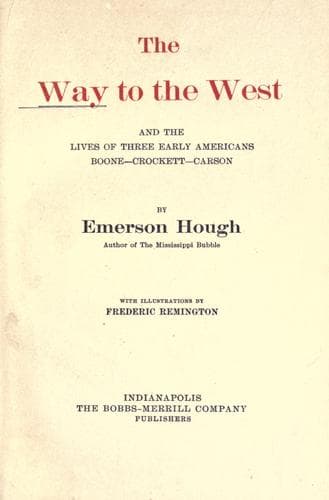
The Way to the West, and the Lives of Three Early Americans: Boone—Crockett—CarsonHough, Emerson
History
The Way to the West, and the Lives of Three Early Americans: Boone—Crockett—Carson
Hough, Emerson
Boone, Daniel, 1734-1820; Carson Kit, 1809-1868; Crockett, Davy, 1786-1836; Mississippi River Valley -- History; West (U.S.) -- History
Little of the eventful occurred in the long journey across Kansas to
Fort Laramie, and so at last they arrived at the South Pass, having met
no Indians at all, although they had feared the Sioux. Frémont rode
across the gentle summit so long known to the fur traders, climbed the
mountain that was later named for him, and returned to Fort Laramie in
September, 1842. Thus ended his first expedition, which began his
reputation as a “pathfinder.” Let him who has followed the travels of
Kit Carson in the trapping trade state who was the real finder of the
paths.
After the first Frémont expedition, Carson returned to Bent’s Fort, and
in February of 1843 married the young Mexican woman who remained his
faithful companion throughout his life. Carson was sent with a message
to Governor Armijo with a warning for the latter, but one hundred of the
Mexicans connected with Armijo’s wagon train were killed by the Texans
on the historic wagon road up the Arkansas River; we being thus now in
touch with the strong and warlike population that, led by Houston,
Travis, Fannin, Crockett, had been fighting the Spanish arms to the
southward of Carson’s hunting grounds.
Up to this time Kit Carson had been more savage than civilized. He had
never cast a vote for any office. He had lived on the product of his
rifle. He had learned the habits of the wild men and wild animals of the
West. Yet he seems to have gained something of that forcefulness and
self-confidence which sooner or later is bound to impress itself upon
others; for on May twenty-ninth of 1843 we find Frémont again sending
for him, and asking his services as guide for his second expedition.
This time it was Frémont’s purpose to connect his last year’s work with
the Pacific Coast surveys which had been begun by Wilkes. All know how
Frémont exceeded his orders, how his wife pluckily held back from him
the knowledge of his recall, and how this transcontinental expedition,
by no means the first, though one of the most widely acclaimed, made its
way over grounds new to Frémont but old to Carson. The first part of the
journey was among the old trapping grounds along the North Fork of the
Platte and on the Sweetwater, thence to Salt Lake—all points fully
known to the fur trade many years before. The journey thence ran to Fort
Hall and along the perfectly determined trail northwest to the Columbia
River. Frémont then pushed on to Tlamath Lake, Oregon, heading thence
for California.
This country between the Tlamath Lake and the Sacramento valley was new
even to Carson. Everybody supposed[31] that there was a great river,
known as the Buena Ventura, which rose on the west side of the Rocky
Mountains at a point directly opposite the headwaters of the Arkansas,
and flowed westward directly into the Pacific ocean. The little fact of
the Sierra Nevada mountain range was wholly overlooked.
Public-domain text, read in full here on John Shaqi.
Reviews
Reviews
No reviews yet
Be the first to share your thoughts on this work.
Elsewhere in the archive
Join the Discussion
Join the discussion
Sign in to leave a comment or review.
Sign InorCreate an account