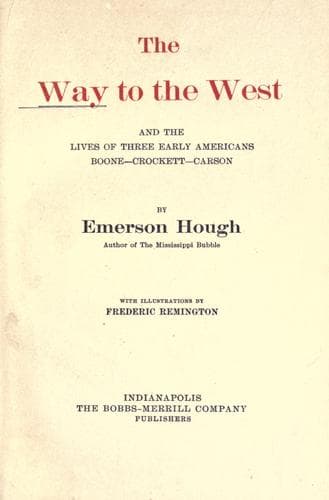
The Way to the West, and the Lives of Three Early Americans: Boone—Crockett—CarsonHough, Emerson
History
The Way to the West, and the Lives of Three Early Americans: Boone—Crockett—Carson
Hough, Emerson
Boone, Daniel, 1734-1820; Carson Kit, 1809-1868; Crockett, Davy, 1786-1836; Mississippi River Valley -- History; West (U.S.) -- History
The first mergers, the first combinations of capital ever made in the
commerce of America began here on the far-off prairies, when the traders
of the Arkansas began to band up and pool their outfits for mutual
protection. The strength of these great companies rendered the danger of
attack by Indians very slight, and it is a fact that but few lives were
ever lost on the Santa Fé trail, scarce a dozen in a dozen years. It was
indeed irony of fate that splendid Jedediah Smith, the hero of such
tremendous undertakings in the mountains of the Northwest, should meet
his fate while hunting for a water hole in the hated desert of the
Cimarron, afar down in the dry Southwest.[34]
By 1824 the Santa Fé trade was well organized. The route was proved
feasible, and the business assured of profit, wherefore many went into
it, and presently the old trail became a great road, later to be very
prominent in the history of the West. The Spaniards did their best to
keep on both sides of the fence in this matter. They wanted the goods of
the Americans, but hated the Americans themselves. They tried to kill
the trade with excessive frontier duties, yet allowed smuggling and
bribery to any limit; and these latter two industries were accepted as
part of the conditions of the trade. The greatest loss of life began to
occur when the fighting Texans from below, actuated by a desire for
revenge and pillage, began to push up and to harass the commerce which
was proving so profitable to Mexico, in spite of Mexico’s vacillation.
These fighting Texans traveled far to the north of the trail, indeed,
and followed the Mexicans into their villages, where they killed them in
numbers. Texas, we must remember, was not yet a state, and little answer
was made to the wail of the thrifty traders, who besought the United
States government to give them protection against the Texans. The latter
did some things not altogether pleasant to recount, but were for the
most part serving nearly right the government of the United States,
which could so long hesitate in accepting Houston’s gift of Texas, the
“bride adorned for her espousal;” which, indeed, so long hesitated to
believe that there was or could be a West really great. Small indeed
were some of the “great” men of that time; and small are some of our
great men to-day.
The common belief is that all the capital engaged in this trade toward
the Southwest was American capital, and that the enterprises ran all one
way. This was not the case, for by 1843 the Mexican capital embarked in
the commerce to the Spanish colonies was about equal to that of the
Americans. The trade grew steadily, even subject as it was to the
caprice of Mexican governments, and of Texas privateers on the high seas
of the prairies.
Public-domain text, read in full here on John Shaqi.
Reviews
Reviews
No reviews yet
Be the first to share your thoughts on this work.
Elsewhere in the archive
Join the Discussion
Join the discussion
Sign in to leave a comment or review.
Sign InorCreate an account