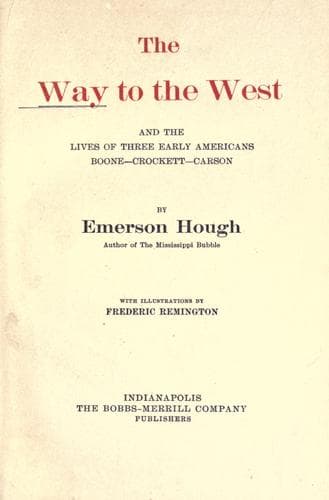
The Way to the West, and the Lives of Three Early Americans: Boone—Crockett—CarsonHough, Emerson
History
The Way to the West, and the Lives of Three Early Americans: Boone—Crockett—Carson
Hough, Emerson
Boone, Daniel, 1734-1820; Carson Kit, 1809-1868; Crockett, Davy, 1786-1836; Mississippi River Valley -- History; West (U.S.) -- History
We learn that in 1831 a party of two hundred persons, with one hundred
wagons and two hundred thousand dollars’ worth of goods, started for
Santa Fé. This party was notable in that one of its members was Josiah
Gregg, a level-headed, shrewd man, who was later to become famous as the
historian of the Santa Fé trail. Nearly all the later histories of that
highway and its peculiarities are based upon Gregg’s able work; which
fact he himself points out with a certain plaintiveness in his later
years (1846), stating that pillagers of his papers did not always stop
to give him credit. Gregg was a big man, a thinker, a man whose sound
sense would succeed in any time. One likens him to the good, sensible
business man of to-day, the mainstay of our republic, the practical
conductor of affairs.
One detail will serve to show how much in advance he was of his time. In
1846 we find the Easterner, Francis Parkman, and his friend Shaw,
killing scores of the great bisons of the plains for no better purpose
than the securing of the tail for a trophy. It makes one blush to read
of such wasteful barbarity as this, which could kill tons and tons of
such creatures and leave the meat to rot on the ground. Our sensitive
Eastern writer Parkman, keen mind and able pen as were his, was a very
savage in his lust for “sport;” indeed worse than any savage, for the
latter never killed for sport alone. Gregg was neither a Parkman nor a
modern “lover of nature,” but something much better, a man of
forethought and of good sense. His protest at the waste of life and food
in the wanton killing of buffalo is one of the most worthy things of his
worthy book. He prophesied what Parkman could not see with all his
florid pictures of the West that was to be—a West soon to be barren of
the great game that did so much to win that West from savagery. The
wicked wastefulness of the killing of the buffalo was one of the
American national crimes. Stout Josiah Gregg saw it and deplored it,
knowing as he did that much of the success of the Southwest trade ever
depended upon the buffalo.
Public-domain text, read in full here on John Shaqi.
Reviews
Reviews
No reviews yet
Be the first to share your thoughts on this work.
Elsewhere in the archive
Join the Discussion
Join the discussion
Sign in to leave a comment or review.
Sign InorCreate an account