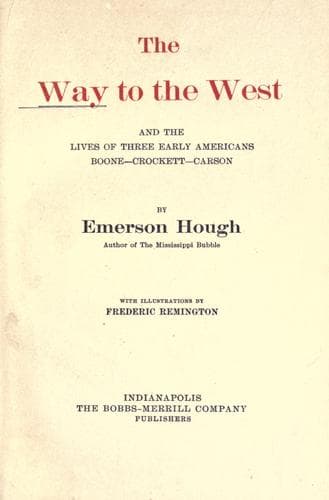
The Way to the West, and the Lives of Three Early Americans: Boone—Crockett—CarsonHough, Emerson
History
The Way to the West, and the Lives of Three Early Americans: Boone—Crockett—Carson
Hough, Emerson
Boone, Daniel, 1734-1820; Carson Kit, 1809-1868; Crockett, Davy, 1786-1836; Mississippi River Valley -- History; West (U.S.) -- History
The way from Santa Fé to California seems to have been well known, but
the trade did not dare to attempt a commerce so distant, and so
unprofitable as it must have been, consumed by such necessarily heavy
transportation charges. We speak of the Santa Fé trail as one of the
great Western highways, but it was a halting and broken and arrested
highway. It was not yet quite time for the straight leap across the
rivers. The trail clung to the rivers as far as it might, and the
attempts to cut loose from the streams, and go straight across from the
Red River to Chihuahua, proved to be unprofitable or impracticable.
The total amount of merchandise carried in these picturesque caravans of
the prairies was perhaps not so great as we should imagine, though we
must remember that a dollar was larger then than it is to-day. The
extent of the trade varied from year to year, and did not regularly
increase; for though we note one caravan in 1831 taking out two hundred
thousand dollars’ worth of goods, we find that in 1841, ten years later,
the whole annual trade was but one hundred and fifty thousand dollars.
The climax was in 1843, when goods to the value of four hundred and
fifty thousand dollars were transported.
The pay for this came back partly in specie, partly in furs, sometimes
largely in horses and mules, the trade thus bearing a double profit and
a double risk. The Indians did not care for gold or silver so much as
they did for horses and mules, and diligent enough were their efforts to
stampede the live stock of the traders. Upon occasion the United States
Army was asked to escort a caravan, but this aid was not generally to be
expected, especially since the worst part of the route, that infested by
the Comanches, lay west of the then accepted western border of the
United States. The average value of the trade was about one hundred and
fifty thousand dollars yearly, and the total sum for the duration of
this strange branch of American commerce was only about three million
dollars.
The goods carried were at first largely prints and drillings, for the
Mexicans got such goods from Vera Cruz on the coast, and only at great
expense. Later silks, velvets, hardware and the general line of American
goods began its first westward way across the American borders.
Sometimes the stocks were retailed, sometimes sold at wholesale, the
latter more often when the trader was in a hurry. It was a wild,
peculiar and fascinating sort of commerce, and strong was the hold it
naturally took upon the people of the Western border.
Public-domain text, read in full here on John Shaqi.
Reviews
Reviews
No reviews yet
Be the first to share your thoughts on this work.
Elsewhere in the archive
Join the Discussion
Join the discussion
Sign in to leave a comment or review.
Sign InorCreate an account