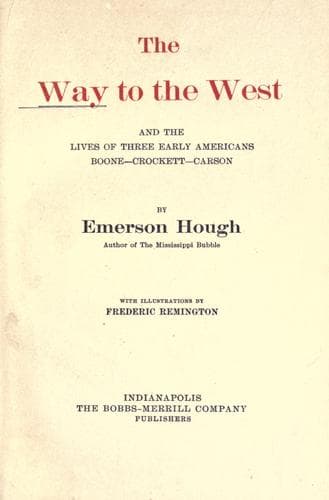
The Way to the West, and the Lives of Three Early Americans: Boone—Crockett—CarsonHough, Emerson
History
The Way to the West, and the Lives of Three Early Americans: Boone—Crockett—Carson
Hough, Emerson
Boone, Daniel, 1734-1820; Carson Kit, 1809-1868; Crockett, Davy, 1786-1836; Mississippi River Valley -- History; West (U.S.) -- History
This trade was carried on mostly by our Southern-Western men, our
new-Americans, as we may see by the letter of the grandson of James
Baird, written from Kentucky. Glenn came from Cincinnati, Fowler from
Covington, Kentucky, most of the other familiar figures from St. Louis,
Franklin and other Missouri points. Morrison, the merchant of Kaskaskia,
was a man who came down-stream. The Northern man, the man of New England
or New York, had not yet become very much of a Westerner. The West was
not yet safe enough for him. Nor indeed was he to lead the vanguard of
the men who, far to the north of the old Santa Fé trail, were building
another, a greater and more significant trail, one whose end we do not
see even to-day; the men that were tapping all the secrets of the upper
Rockies, that were to lead us to the brink of the Western sea and even
to point beyond that sea. But for politics, the Southerners of to-day,
the sons of the old daring ones, would admit the virtue of that finger
pointing over seas.
There is still in New England something of the old timidity, the old
unwillingness to see the pointing finger, the same un-American tardiness
to recognize the challenge of the West. Had it not been for the
fascinations of this upper country, for the allurements of the great
trail that was to run across the continent to the far Northwest, there
had been more competition in the Southwest trade, and mayhap a swifter
crowding of events toward that state of affairs that Parkman saw when he
visited the Santa Fé trail on his way home from the Rockies in 1846—the
volunteers of Missouri, kindred to the men of Doniphan, who were
straggling on out toward Mexico on an errand of justice that had long
been overdue. Shuffling, angular, awkward, uncouth we may, with Parkman,
admit these Southern-Western men to have been; each man his own
commander, reluctant to admit a superior officer, as had been the
fathers of these men from the time they left the Atlantic coast; but
they did the work in Mexico. They opened the trail forever, and saw to
it that the borders stretched and spread and gave us room. It is of no
use to talk politics in questions like these, nor is there need to speak
of the moralities. It is for the most part a matter of transportation.
It was the Arkansas River trail that conquered Mexico.
Public-domain text, read in full here on John Shaqi.
Reviews
Reviews
No reviews yet
Be the first to share your thoughts on this work.
Elsewhere in the archive
Join the Discussion
Join the discussion
Sign in to leave a comment or review.
Sign InorCreate an account