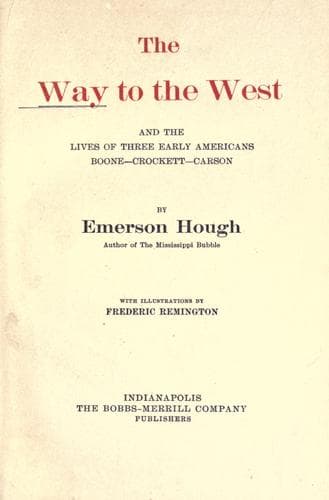
The Way to the West, and the Lives of Three Early Americans: Boone—Crockett—CarsonHough, Emerson
History
The Way to the West, and the Lives of Three Early Americans: Boone—Crockett—Carson
Hough, Emerson
Boone, Daniel, 1734-1820; Carson Kit, 1809-1868; Crockett, Davy, 1786-1836; Mississippi River Valley -- History; West (U.S.) -- History
This, then, was the great thing that the Santa Fé trail did for us,
although we have forgotten it. It taught the people of New Mexico that
the Americans were a greater and stronger people, a more just and
steadfast people, than those to the south, who had done naught in all
their lives but butcher and hesitate, butcher again and vacillate. They
were not sad to take on the institutions of the United States in
exchange for those of Spain. The Old World had not established its ways
on the soil of the New World. The greatest of all Monroe doctrines still
prevailed, the doctrine of the fit, the doctrine of evolution, of
endurance by right, of hardihood got by a sane dwelling close to the
great things of nature.
Far to the north, the Oregon trail led to California and the Orient. The
Santa Fé trail, broken as it was in its transcontinental flight, points
now in the same direction. The only ignoble part of the American story
is the history of American politics. All politics aside, is it not easy
to see that the old broken trail is a fate-finger pointing to Mexico and
the trans-Isthmian canal; to an America wholly American; and to an
Orient that again and by another trail is destined to be our West? We
may spill our oratory, may deplore utterly and sincerely, yet we shall
not prevail to build any wall high enough to stop this thing. The Old
World might combine for the time against the New, might for a term of
years conspire to put our venturers in prison; but at last it all were
futile. Much of the temperate zone of the world belongs to a people
whose history is but the history of a West; it will always so belong
while the character of that people shall retain the dignity and force of
those men who “could not otherwise.”
This people is concerned to-day, as it has always been, not with
sentiment but with self interest. Its great movements have been based
not on theories but on common sense. Its great policies have been
founded on geography and not on polemics. Its great adversities have
been those of transportation; its great successes have been those built
on transportation problems ably mastered. To-day this American people
waxes somewhat flamboyantly boastful, according lightly and cheerfully
to itself the title of the greatest nation of the world. It may indeed
be such, or potentially such; but it will retain better claim upon that
greatness if in all humility it shall remember the slow days wherein
that greatness was founded, wherefrom that greatness grew. Therein lies
the import of the early Western trails.
-----
Footnote 33:
The spelling of this name is by most authorities given as “Becknell,”
which is thought to be correct.
Footnote 34:
V. Chapter IV, Vol. III; “Early Explorers of the Trans-Missouri.”
Footnote 35:
Other authorities, as for instance Chittenden, make it 392 miles.
CHAPTER III
THE OREGON TRAIL
Public-domain text, read in full here on John Shaqi.
Reviews
Reviews
No reviews yet
Be the first to share your thoughts on this work.
Elsewhere in the archive
Join the Discussion
Join the discussion
Sign in to leave a comment or review.
Sign InorCreate an account