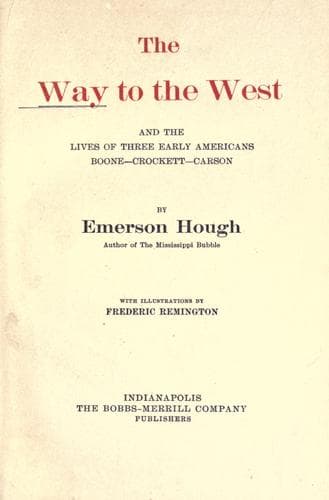
The Way to the West, and the Lives of Three Early Americans: Boone—Crockett—CarsonHough, Emerson
History
The Way to the West, and the Lives of Three Early Americans: Boone—Crockett—Carson
Hough, Emerson
Boone, Daniel, 1734-1820; Carson Kit, 1809-1868; Crockett, Davy, 1786-1836; Mississippi River Valley -- History; West (U.S.) -- History
In the distribution of the population of Western America, the mouths of
many great Western rivers, the Mississippi, the Missouri, the Columbia,
the Colorado, the Red, the Sacramento, the Arkansas, perhaps even the
Ohio, were known before their sources were fully explored. The journey
over the Appalachians, and the down-stream movements that followed the
Mississippi and its greater tributaries, were the first concerns of our
new-American emigrants. The lower reaches of the great Western rivers
having been utilized, the first two decades of the century last past
were spent in the search for the head waters of these same streams.
Lewis and Clark followed up the tortuous Missouri until they reached at
least a practical conclusion as to its sources. Lieutenant Pike mistook
the upper Rio Grande for the head of the Red River, and it cost him a
long walk to Chihuahua. Yet he was as accurate as the famous Baron von
Humboldt, who thought the Pecos River was a tributary of the Red. Major
Long, in 1820, dropped down from the South Fork of the Platte to the
head waters of the Cimarron, which he traced to the Canadian, also
missing the Red River which he sought, and taking the Canadian river to
be the Red.
Scores of similar errors were made in those days before the maps, but
still the explorations went on. The head waters of the Columbia, of the
Green, of the Sacramento or “Buena Ventura,” offered challenge to many
bold men, the story of whose exploits forms one of the most glowing
chapters of American hero history. These divers pursuits, these
evidences of an up-stream travel and traffic, more properly group
themselves under our second general head of up-stream transportation.
Next there was to come the day of transportation across the waters, from
stream to stream.
Among those men who early in the past century pressed out most boldly in
the quest for the heads of the upper Western waters, we continue to find
our men of the South very prominent, the sons of the men that moved west
from Virginia, Kentucky and Tennessee into Missouri and other parts of
the trans-Mississippi. Many of these made the old town of St. Louis
their general starting point, and St. Louis was, in those days, much
more a Southern or Western town than it is to-day. As in the time of the
Santa Fé trail, the Western man was still what we should call to-day a
Southerner.
Public-domain text, read in full here on John Shaqi.
Reviews
Reviews
No reviews yet
Be the first to share your thoughts on this work.
Elsewhere in the archive
Join the Discussion
Join the discussion
Sign in to leave a comment or review.
Sign InorCreate an account