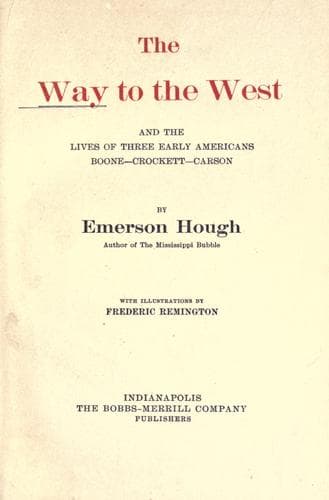
The Way to the West, and the Lives of Three Early Americans: Boone—Crockett—CarsonHough, Emerson
History
The Way to the West, and the Lives of Three Early Americans: Boone—Crockett—Carson
Hough, Emerson
Boone, Daniel, 1734-1820; Carson Kit, 1809-1868; Crockett, Davy, 1786-1836; Mississippi River Valley -- History; West (U.S.) -- History
The greater number of the leaders of the fur trade were properly to be
called Western-born citizens. A few exceptions to this rule are worthy
of note. John Jacob Astor was the first of the Eastern merchants to send
out a commercial expedition into the far West; but really the first
notable Eastern explorer personally to engage in exploring the head
waters of distant Western rivers was Nathaniel J. Wyeth, of
Massachusetts, who, in 1832, led the first continuous expedition from
New England to the mouth of the Columbia, a man whose pluck and energy
deserved a better fate than he encountered. It was this same Wyeth who,
in 1834, founded one of the first establishments west of the Rockies,
that Fort Hall, often mentioned in the story of the fur trade, which was
afterward sold to the Hudson Bay Company. Fort Hall was a trading post
of much note in earlier times, and it is of interest to us at this
juncture, in view of the fact that it was located on that great roadway
later to be trod by thousands of feet that had begun their journey
farther to the eastward than the valley of the Mississippi—the roadway
to be known as the Oregon trail.
There was early need for a trail to Oregon. The first of the hardy
trappers of the Northwest told us about Oregon; and had we heeded them,
we might to-day have an Oregon of continuous American territory running
north to Alaska. Our trappers offered us this empire. Our “leaders” lost
it for us. As it was, we nearly lost what Oregon we have to Great
Britain and her own hardy trappers. Wyeth and his friends brought back
word to the East, which at last the ever hesitating, ever doubting
Eastern men believed. At last we summoned together our senses, our
halting diplomacy, with the result that we kept our marches intact to
the Western sea. This we were able to do simply because of the
individual search that had been going on for the head waters of the
Western streams, because the Western men had already made for us that
Oregon trail, which gave us touch with the far-off American provinces
beyond the Rockies.
To-day, to the average resident of the Middle West, Oregon seems farther
away than California; but up to the middle of the last century it was
much nearer and much better known; and it was so solely because, under
the existing conditions of travel, it was more accessible. The Santa Fé
trail did not go to California. The Oregon trail did go to Oregon, and
over a plain and easy route.
The Oregon trail left the Missouri River, as did the Santa Fé trail, at
that early citadel of the trade of the West, the town of Independence.
It followed up the ancient valley of the Platte, immemorial highway of
the tribes, and led to the head waters of many streams now historic,
even then long familiar to many of our early trappers and traders.
Public-domain text, read in full here on John Shaqi.
Reviews
Reviews
No reviews yet
Be the first to share your thoughts on this work.
Elsewhere in the archive
Join the Discussion
Join the discussion
Sign in to leave a comment or review.
Sign InorCreate an account