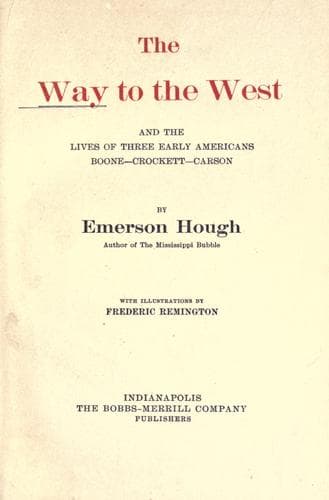
The Way to the West, and the Lives of Three Early Americans: Boone—Crockett—CarsonHough, Emerson
History
The Way to the West, and the Lives of Three Early Americans: Boone—Crockett—Carson
Hough, Emerson
Boone, Daniel, 1734-1820; Carson Kit, 1809-1868; Crockett, Davy, 1786-1836; Mississippi River Valley -- History; West (U.S.) -- History
We have heard of Andrew Henry, whose name was given to a beautiful lake
of the Rockies, as well as to a once famous trading post across the
range, the lieutenant whose man, Etienne Provost, probably discovered
the South Pass. We know of the trader Jackson, one of General Ashley’s
bold mountain family, whose name was left to the beautiful valley below
the Yellowstone Park, called even to-day Jackson’s Hole. We have heard
of the wanderings of Campbell, Fitzpatrick, Sublette, of Jim Bridger,
and of General Ashley himself, prince of early mountain traders, father
of a bold crew of young successors. We shall presently speak of
Bonneville and his northern wagons, and of Bonneville’s man Walker,
bigger than himself. We must also trace a part of the march of the first
land party to cross this continent, the Astorians, whose broken
journeyings down the Snake and Columbia made part of the earliest
trail-history of the West.
All these different leaders and individuals had much to do with the
Oregon trail; the trail that was the road of the adventurers, and also
the first real road to the Pacific for that traveler properly to be
called the home-seeking man. The Missouri River would do for Manuel Lisa
and General Ashley and Major Henry, and the Sublettes, and the
Chouteaus, and all those others that held the scores of trading posts
which dotted the upper waters of the Missouri and the Yellowstone. The
Missouri River and its tributaries gave them their natural roadways; but
all these scattered posts, all this devious ancient roadway of the
waters, lay far to the northward, on the upper curve of a great arc, the
winding way traced out by Lewis and Clark, the way of the up-stream
wanderers. The streams ever appealed to explorers. Any man going into
unknown country instinctively clings to the waterways, near which he
always feels safer. Yet it was the way between and across the streams
that spoke most loudly to those settlers that came to stay, to till the
soil, who brought with them household goods, who brought ax and plow as
well as trap and rifle. The ancient highway for footmen and horsemen,
which ran up the valley of the Platte River, extended out along the
chord of this great Missouri River arc, along the string of this vast
bended bow.
The string of this great bow ran four degrees of latitude to the south
of the upper curve of the Missouri. Evidently the line of the bow-string
was the better way to the Pacific; the more especially since itself
followed for so great a distance another preordained pathway of the
waters—that of the river Platte, ancient road of the Indian tribes. It
was within natural reason, therefore, that the travelers should break
away, should leave the upper waterway and start directly overland. This
came to pass because there were now horses to be obtained in the West.
We are now come to the time of horse transportation; which was the
beginning of the day of travel across the streams.
Public-domain text, read in full here on John Shaqi.
Reviews
Reviews
No reviews yet
Be the first to share your thoughts on this work.
Elsewhere in the archive
Join the Discussion
Join the discussion
Sign in to leave a comment or review.
Sign InorCreate an account