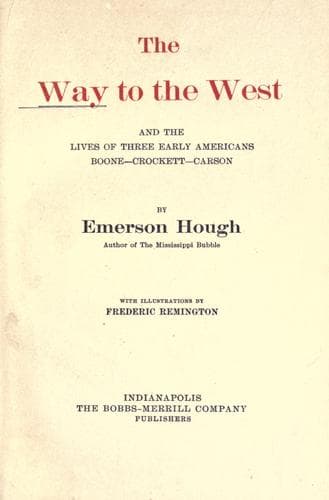
The Way to the West, and the Lives of Three Early Americans: Boone—Crockett—CarsonHough, Emerson
History
The Way to the West, and the Lives of Three Early Americans: Boone—Crockett—Carson
Hough, Emerson
Boone, Daniel, 1734-1820; Carson Kit, 1809-1868; Crockett, Davy, 1786-1836; Mississippi River Valley -- History; West (U.S.) -- History
Along this great trail crossing the waters men bent their steps toward
Oregon and California, men from the banks of the Missouri, from
Illinois, and now even from far-off New England—where at last they had
learned the “easy way West” and had begun to travel, as their friends to
the southward had been doing for so many years. Thus, then, began the
great Oregon trail, this road that might, with justice, have been called
an open highway when Frémont “explored” the Rockies, albeit a highway
almost unsettled, as it is to-day over much of its length, though
peopled thick with mighty memories. The Mormons, the Missourians, the
men bound for the placers of Montana, the valleys of California, or the
warm slopes of the Oregon ranges—all these helped wear deep into the
earth the old roadway, once clear-cut and unmistakable for more than two
thousand miles west of that Missouri River which was the first route out
into the ulterior West.
It may profit us to fix in sequence a few simple facts in the study of
the development of this great trail. At the start, of course, we come to
our Frenchman De la Verendrye, who may perhaps have been the first to
tread a portion of the later Oregon trail; since we know he forsook the
Missouri and started overland, possibly up the Platte, crossing some of
the country which the Astorians later saw. We hear also of the trapper
Ezekiel Williams[36] in 1807, and some of the advance guards of the
Missouri Fur Company, who were cutting loose from the Missouri River,
and who were naturally looking for the easiest land routes. Then came
Wilson Price Hunt, with his overland Astorians, seeking a way from the
mid-Missouri River to the Columbia River.
These established the course of the Oregon trail west of the Rockies,
but did not trace it so distinctly on the east of that range. Later
Robert Stuart and the returning Astorians were to mark out, east of the
Divide, the route of the Oregon trail for much of its length. Then came
Ashley, who went up the Platte and across the South Pass; and after
Ashley came scores of other flap-hatted trappers and traders, all of
whom rode, we may be sure, along the easiest ways; which meant the
Sweetwater and the South Pass after the Platte was left behind. These
followed the route of the Oregon trail for the compelling reason of
topography. Now came Bonneville and his wagons to deepen the trail, in
1832; and two years later than that, in 1834, Robert Campbell and
William Sublette built old Fort Laramie, on Laramie Creek, a branch of
the Platte.[37] This establishment went far toward developing the Oregon
trail into a regular route. It became a well known trading center, so
that all the trappers and many Indians rounded up there; and in the days
of the emigrants, soon to come, thousands of weary travelers aided in
marking deeply the now unmistakable and open roadway that lay across the
Rockies.
Public-domain text, read in full here on John Shaqi.
Reviews
Reviews
No reviews yet
Be the first to share your thoughts on this work.
Elsewhere in the archive
Join the Discussion
Join the discussion
Sign in to leave a comment or review.
Sign InorCreate an account