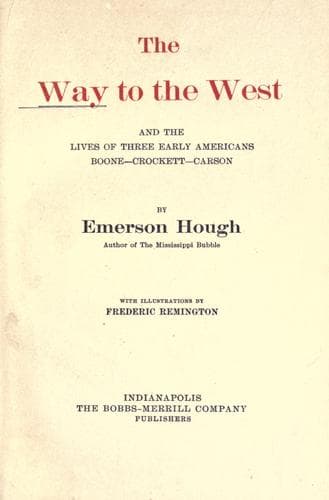
The Way to the West, and the Lives of Three Early Americans: Boone—Crockett—CarsonHough, Emerson
History
The Way to the West, and the Lives of Three Early Americans: Boone—Crockett—Carson
Hough, Emerson
Boone, Daniel, 1734-1820; Carson Kit, 1809-1868; Crockett, Davy, 1786-1836; Mississippi River Valley -- History; West (U.S.) -- History
There was a time when every Western man, still restless, still
unsettled, still under the mysterious west-bound impulse, thought in
terms of Oregon and California. No wall could have stopped these men. No
political doctrine could have restrained them. As well try to regulate
the sweep of the tides of ocean, equally mysterious, equally
irresistible. This great road of the prairies and the mountains, more
than two thousand miles long, and level, smooth and easy, even though it
crossed a continental divide—this unengineered triumph of
engineering—lay directly at hand as the natural pathway of the American
people. It was the longest highway of the world, unless that may be the
trail of the convicts of Siberia, to reach whose terminus in the
fullness of time this great trail of the American freemen seems to have
been devised. It was the route of a national movement—the emigration of
a people “seeking to avail itself of opportunities that have come but
rarely in the history of the world, and will never come again.”
As has been stated, the overland trail to Oregon began, as did the Santa
Fé trail, at the town of Independence, on the Missouri River. The two
trails were the same for forty-one miles, when, as the able historian of
the fur trade remarks, a simple sign board was seen which carried the
words, “Road to Oregon.”[41] The methods of these old men were very
direct and simple. There was small flourish about this little board,
whose mission was to point the way across these miles of wild and
uninhabited country! There were branch trails that came into the road
from Leavenworth and St. Joseph, striking it above the point of
departure from the Santa Fé trail; but the Oregon trail proper swung off
from this fork, running steadily to the northwest, part of the time
along the Little Blue River, until at length it struck the valley of the
Platte, which was so essential to its welfare. The distance from
Independence to the Platte was three hundred and sixteen miles, the
trail reaching the Platte “about twenty miles below the head of Grand
Island.” The course thence lay up the Platte valley to the two fords,
about at the Forks of the Platte, four hundred and thirty-three or four
hundred and ninety-three miles.
Here at the Forks was a point of departure in the old days. If one chose
to follow the South Fork of the Platte, he might bring up in the Bayou
Salade, within reach of the Spanish settlements and the head of the
Arkansas, as we may see in reading of La Lande and of Purcell and of
Ashley, and of the later traders; or he might take the other arm and
come out on the edge of the continental Divide much higher up to the
north.
Public-domain text, read in full here on John Shaqi.
Reviews
Reviews
No reviews yet
Be the first to share your thoughts on this work.
Elsewhere in the archive
Join the Discussion
Join the discussion
Sign in to leave a comment or review.
Sign InorCreate an account