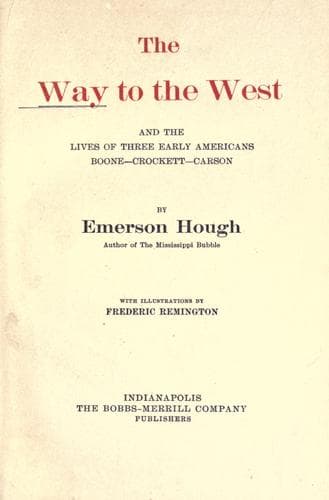
The Way to the West, and the Lives of Three Early Americans: Boone—Crockett—CarsonHough, Emerson
History
The Way to the West, and the Lives of Three Early Americans: Boone—Crockett—Carson
Hough, Emerson
Boone, Daniel, 1734-1820; Carson Kit, 1809-1868; Crockett, Davy, 1786-1836; Mississippi River Valley -- History; West (U.S.) -- History
Here, then, was indeed an ancient and historic pathway, one not used
to-day by any rails of iron, nor followed even by the pack trains of the
“adventurers” of to-day. Here was a pass discovered, no man may tell
when, by Indians who wandered eastward and westward across the upper
Rockies. Perhaps the old trappers also know this trail; though there are
not wanting those who believe that less than a double decade ago the
valleys at the headwaters of the St. Mary’s Lake still lay untouched by
the foot of white man. Here, along this forgotten mountain trail, came
the Kootenais with their war parties against the Blackfeet. Here,
perhaps, came, from the upper Pacific coast, the first horses used by
the plains Indians in the far North. Be that as it may, my companion and
I without doubt stood on one of the original or aboriginal pathways; and
he had been dull indeed who did not find an interest in that fact and in
the surroundings.[47]
“Who made the first Indian trails?” I asked of my friend, as we stood at
the eastern end of this old pathway. He pointed to similar paths
crossing the sides of the ridge near to us, and other little paths
leading up the valley along the sides of the mountains.
“It was the elk and the deer and the mountain sheep,” said he. “They
found the easiest ways to travel; they found the grass and the water.”
-----
Footnote 44:
All of these maps, by the way, must have been at the disposal of
Frémont; yet we do not learn that he believed the east and west course
of the Buena Ventura was an impossibility, although Jedediah Smith had
long since shown the inaccuracy of this old idea, which later was to
cost Frémont so much suffering in the mountains of upper California.
Footnote 45:
Again, remember this significant date of 1834.
Footnote 46:
This story of an alleged captivity among the Indians, extending from
childhood to young manhood, is by some considered unauthentic. The
volume, a curious one, was printed in London, in 1825.
Footnote 47:
The trail of the white race over the Appalachians was but the trail of
the red men. The Sioux Indians, for generations inhabitants of the
upper plains country of the West, formerly lived east of the
Appalachians. The first settlers of Kentucky and Tennessee simply
followed the ancient ways by which the Indians crossed into the valley
of the Mississippi. And there, as in the West, the Indians but
followed the paths of the wild animals, which clung nearly as possible
to the courses of the streams.—V. “The Indians of To-day;” Grinnell.
CHAPTER V
ACROSS THE WATERS[48]
Public-domain text, read in full here on John Shaqi.
Reviews
Reviews
No reviews yet
Be the first to share your thoughts on this work.
Elsewhere in the archive
Join the Discussion
Join the discussion
Sign in to leave a comment or review.
Sign InorCreate an account