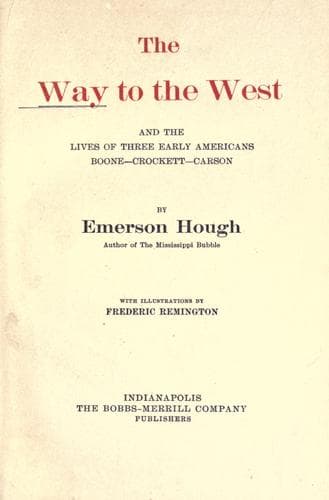
The Way to the West, and the Lives of Three Early Americans: Boone—Crockett—CarsonHough, Emerson
History
The Way to the West, and the Lives of Three Early Americans: Boone—Crockett—Carson
Hough, Emerson
Boone, Daniel, 1734-1820; Carson Kit, 1809-1868; Crockett, Davy, 1786-1836; Mississippi River Valley -- History; West (U.S.) -- History
Twenty-five years ago potatoes were so high in price in certain towns of
the Rocky Mountains that the merchants handling them often reserved the
right to retain the peelings, which, in turn, were sold, for planting
purposes, the eyes of the potatoes thus having a considerable commercial
value, obviously in proportion to the distance from the nearest railroad
or steamboat line. This situation could not forever endure. There must
come a day when we could afford to throw away our peelings, and throw
them away cut thick and carelessly. Equally true is it that the time is
coming in America when we shall again gather up our potato-peelings and
cherish them. There you have the three ages of the West.[49]
The early American life was primitive, but it was never the life of a
peasantry. Look ahead into the future, the time of the second saving of
the peelings. Once there was a time in the West when every man was as
good as his neighbor, as well situated, as much contented. It would take
hardihood to predict such conditions in the future for the West or for
America.
For half a hundred years America looked across the Alleghanies. It was
nearer to England than to Iowa. Our standards in fashion, in art, in
literature, were yet those of an older world. Then came the age of
Americanism, when it mattered not to the women of the frontier what were
the modes brought in the latest ship from London or Paris. Under the
Monroe doctrine of the frontier the women made their petticoats of
elkskin, and found it good. Behold now a day when Iowa is as near as
England, and England almost as near as New York. Again the contents of
the ships are valid matter of curiosity to the women of the West.
We are in the third age, the age of steam. The pack-horse and the
sailboat were vehicles of the individual or of the section. Wheeled
vehicles afforded a speedier and more flexible intercommunication that
made the idea of secession forever impossible, and made us a national
America. The common carrier made us and will destroy us as a national
entity. The wheels have written epochal record on the surface of the
land. Long and devious and delightful, weary and sad and tragic, are the
old wheel-tracks of the West, worn deep into a soil red with blood, on
paths lined with flowers, and with graves as well.
At the half-way point of the century the early wheels of the West were
crawling and creaking over trails where now rich cities stand. The Red
River carts from Pembina, their wheels sawn from the ends of logs, and
voicing a mile-wide protest of unlubricated axle, crept down to a “St.
Paul’s” that had a population of about twelve hundred, mostly
halfbreeds.[50] A yard of cloth or a butcher-knife still sold for twenty
dollars at old Fort Benton in the beaver country.
Public-domain text, read in full here on John Shaqi.
Reviews
Reviews
No reviews yet
Be the first to share your thoughts on this work.
Elsewhere in the archive
Join the Discussion
Join the discussion
Sign in to leave a comment or review.
Sign InorCreate an account