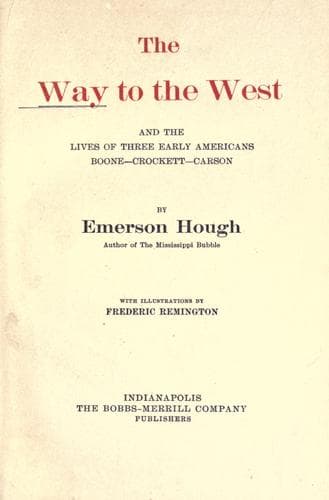
The Way to the West, and the Lives of Three Early Americans: Boone—Crockett—CarsonHough, Emerson
History
The Way to the West, and the Lives of Three Early Americans: Boone—Crockett—Carson
Hough, Emerson
Boone, Daniel, 1734-1820; Carson Kit, 1809-1868; Crockett, Davy, 1786-1836; Mississippi River Valley -- History; West (U.S.) -- History
The Western railroads were only little spurs of iron thrusting out into
the prairies. Indeed, they could not always boast rails of iron, as
witness the old wooden-railed road from Chicago to Galena. Still eager,
still harkening to the Voices of the West, the men who were to make the
West pressed on, taking the railway as far as it went, then the
stage-coach and the wagon and the horse and the lone path of the
farthest venturer.
The man of Virginia heard that the prairies of Iowa would give him a
farm for a price per acre less than one-tenth that commanded by the red
clay hills of the Old Dominion. He forsook the land of terrapin and
peaches, of honeysuckle and sunshine, and started West by rail across
the Alleghanies, across Ohio by the early Pennsylvania railway system,
beyond the boom town of Chicago, across the Mississippi, and out into
the black mud of the prairies for fifty miles or so. Thence by stage he
went, the head of his tearful wife against his breast, but in that
breast beating a heart whose one thought was the “better chance.” It was
the better chance for these babes that tugged at the skirts of their
mother—this was what the father wanted, and this was why the mother
went with him, grieving, as she yet must, for the home land that she
perhaps would never see again.
One such settler, who went West from Virginia into an agricultural state
in 1854, said that he came West in order that he might be able to
educate his children. He educated them. To-day one child is buried in
California, one in Dakota, three live in Iowa, and one in Illinois. Such
is the typical record of an American family.
The man of old New England might cross this trail of the Southern man,
and find himself betimes in Kansas or Nebraska, forerunner of that day
when it was to be said that Massachusetts was west of the Missouri
River, as indeed is true to-day. Boston began to build Chicago, and the
first of those men went West that were to make the old Red River
cart-towns of St. Paul and Minneapolis little else than New England
communities—cities of a state which to-day has a permanent school fund
of nearly eight million dollars, and a university fund of nearly one
million dollars, in securities largely made up of the bonds of other
states, among them a large amount of the funding bonds of the ancient
state of Virginia. It was a race into the West—a race in which now the
North outstripped the South, the commercial outran the heroic, the ax
and the plow outstripped the rifle and its creed.
Public-domain text, read in full here on John Shaqi.
Reviews
Reviews
No reviews yet
Be the first to share your thoughts on this work.
Elsewhere in the archive
Join the Discussion
Join the discussion
Sign in to leave a comment or review.
Sign InorCreate an account